Materials Mechanics
Monocular 3D Video Extensometer



Monocular 2D Optical Strain Measurement System
Monocular 3D Optical Strain Measurement System
High-Speed Monocular 3D Optical Strain Measurement System
Stereo 3D Optical Strain Measurement System
Optical Strain Measurement System – Educational Edition
2D Optical Microscopic Strain Measurement System


Strain Measurement of Parallel Lap Welds
Residual Deformation Measurement of Drilled Welded Plates
Full-Field Strain Measurement of Weldments in Compression
Tensile Deformation Measurement of 0.3mm Fiber Filament
Unmarked Compression Deformation Measurement of Composite Materials

Deformation Measurement of Artificial Cardiac Patch
Keycap Vibration Measurement: Quantifying Press and Rebound Dynamics
Headband Deformation Measurement: Analyzing Bending Position and Unloading Recovery
High-Temperature DIC Measurement of Wafer Thermal Warpage: Quantifying Warpage vs. Temperature
UAV Dynamic Tracking Measurement: Capturing Flight Trajectory and Attitude Changes

 0755-86347753

 Glass tensileVideo extensometer
Glass fiber materials are widely used in aerospace, construction, automotive, and other industries thanks to their light weight and high strength. To ensure the reliability of glass fiber materials in practical applications, testing their mechanical properties, especially tensile properties, is particularly important. Conventional tensile testing methods usually rely on contact extensometers or strain gauges, which can face problems such as difficult installation and limited measurement accuracy when dealing with the complex deformation of fiber materials.
1. Testing Process
The Haytham monocular 3D video extensometer was adopted for this tensile test of glass fiber material. Before testing, the specimen was clamped in the tensile testing machine, and the extensometer captured the surface deformation of the glass fiber specimen during tension through a monocular camera. The device analyzes the acquired images using digital image correlation (DIC) technology and computes the strain distribution of the specimen in real time.
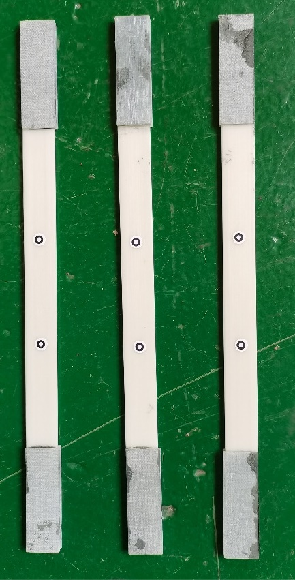
Marked points on the glass fiber specimen
Glass fiber fracture process
Because glass fiber materials may exhibit complex phenomena such as localized deformation concentration and fracture during tension, the non-contact measurement of the Haytham monocular 3D video extensometer avoids the interference and errors that can be caused by attaching a conventional extensometer to the specimen surface. In addition, the device provides real-time full-field strain data of the specimen during tension, which is essential for understanding the tensile performance and fracture mechanism of the material.
2. Test Results
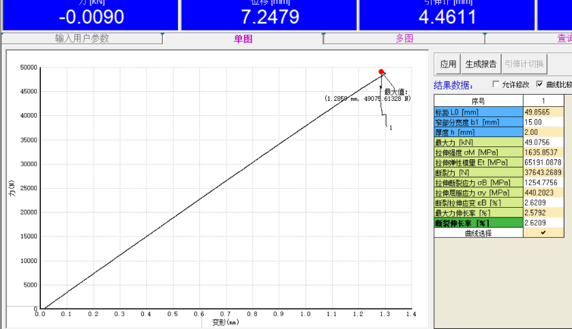
In this test, the Haytham monocular 3D video extensometer successfully captured the strain distribution and deformation behavior of the glass fiber material during tension. The test data revealed the tensile performance of the material under different stress states, including key mechanical parameters such as elastic modulus and fracture strain. These data provide an important reference for evaluating the performance of glass fiber materials in practical applications.





 Downloads

