Materials Mechanics
Monocular 3D Video Extensometer



Monocular 2D Optical Strain Measurement System
Monocular 3D Optical Strain Measurement System
High-Speed Monocular 3D Optical Strain Measurement System
Stereo 3D Optical Strain Measurement System
Optical Strain Measurement System – Educational Edition
2D Optical Microscopic Strain Measurement System


Strain Measurement of Parallel Lap Welds
Residual Deformation Measurement of Drilled Welded Plates
Full-Field Strain Measurement of Weldments in Compression
Tensile Deformation Measurement of 0.3mm Fiber Filament
Unmarked Compression Deformation Measurement of Composite Materials

Deformation Measurement of Artificial Cardiac Patch
Keycap Vibration Measurement: Quantifying Press and Rebound Dynamics
Headband Deformation Measurement: Analyzing Bending Position and Unloading Recovery
High-Temperature DIC Measurement of Wafer Thermal Warpage: Quantifying Warpage vs. Temperature
UAV Dynamic Tracking Measurement: Capturing Flight Trajectory and Attitude Changes

 0755-86347753

 PRODUCT
The High-Speed Monocular 3D Optical Strain Measurement System is based on monocular 3D DIC technology. High-speed DIC testing can be performed using only one high-speed camera and lens, effectively reducing overall system costs. Its optical configuration is compatible with commonly available high-speed cameras and lenses. The compact system design makes it suitable for confined spaces and small-field-of-view measurement applications.


High Repeatability

Standardized Measurement

Sampling Rate up to 100,000 Hz

Monocular 3D DIC

 Drop-weight impactHigh-speed camera
In pyrite drop-weight impact tests, capturing dynamic deformation under high-speed impact is essential for understanding impact toughness. Traditional methods struggle with precision and speed in such fast, complex events. Non-contact DIC measurement records the full process and delivers reliable full-field strain data.
 High-speed cameraHigh-speed vibration testing
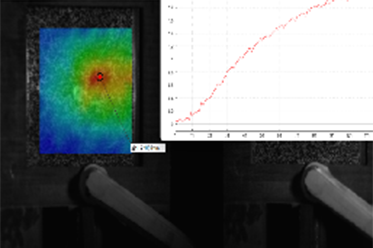
When an air conditioning system starts, runs, and stops, each part generates corresponding stress and vibration. Without detection and control, severe vibration not only creates more noise but also accelerates fatigue damage to the compressor, piping, and related parts, shortening the service life of the outdoor air conditioner unit. Vibration DIC testing helps find and correct such problems early.
 High-speed cameraHigh-speed dynamic testing
The wall panel projectile test is a common method for simulating wall panel material behavior under high-speed impact. In this highly dynamic, high-strain-rate environment, traditional strain measurement struggles to provide accurate full-field data, so a technique with high-speed, non-contact full-field capability is essential.
 Hopkinson impact testingHigh-speed DIC
When testing small specimens, Hopkinson bar (SHPB) impact testing demands high precision and high-speed response to capture strain changes within extremely short timeframes. Traditional strain measurement equipment struggles with small specimens and high-speed dynamic tests, limiting the strain data engineers can obtain.
 High-speed cameraHigh-speed vibration testing
As a key power system component, reactor stability and reliability directly affect operational safety. Electromagnetic forces can induce vibration during operation, and vibration beyond a certain limit may damage equipment. DIC-based vibration testing helps engineers monitor reactor vibration and safeguard system reliability.
 Digital image correlation (DIC)DIC system
Highly accelerated life testing (HALT) quickly evaluates the performance and durability of PCB circuit boards under extreme conditions such as rapid temperature cycling, mechanical shock, and vibration. By exposing potential weaknesses early, it helps engineers improve product reliability before mass production.
 Digital image correlation (DIC)High-speed vibration
Automotive horns endure high-speed vibration during operation, and prolonged use can degrade performance or cause failure. High-speed vibration testing is essential to ensure durability. Traditional methods capture only limited point data, while DIC full-field measurement tracks vibration response across the horn.
 High-speed dynamic testingHigh-speed camera
The lithium battery nail penetration test simulates a battery being pierced by a sharp external object. It is vital for evaluating lithium battery safety, helping identify potential hazards such as internal short circuits when cells suffer physical damage, and supporting safer battery design and verification.
 High-speed dynamic testingHigh-speed camera
High-speed rotating bearings are widely used in aerospace, automotive, and industrial machinery, enduring enormous centrifugal forces and mechanical stress in operation. To ensure reliability and service life at high rotational speed, strict strain testing is essential, and DIC captures bearing strain in full field at 8000 rpm.
 DIC technologyDigital image correlation
In rock core compression strain testing, DIC (digital image correlation) has become an important non-contact measurement method. Using the Haytham high-speed visual strain gauge, DIC measures full-field strain of the rock core throughout compression, giving engineers detailed insight into deformation and failure behavior.
 DIC technologyDigital image correlation
As new energy vehicles develop rapidly, battery safety and durability are a priority. Battery packaging composite film is widely used to enclose and protect cells for good mechanical properties and weather resistance. Biaxial tensile DIC testing of this film reveals full-field strain behavior and supports packaging design.
 DIC technologyNon-contact deformation measurement
The Venus flytrap (Dionaea muscipula) is a famous carnivorous plant whose unique leaf-closing mechanism allows it to capture insects rapidly. The closing motion of its leaves is not only fast and reversible but also structurally simple and efficient, making it an ideal object for DIC measurement and a valuable reference for bionic mechanics research.
 High-speed impact testingFull-field deformation measurement
As a core part of vehicle safety evaluation, how the steering wheel column behaves at the moment of impact directly affects driver safety. The Haytham monocular 3D high-speed visual strain gauge measures full-field strain and deformation during impact, giving engineers data to optimize steering column structural safety.
 DIC technologyTungsten wire vibration testing
Tungsten wire has a very small diameter and low vibration amplitude, so traditional sensors are hard to attach. The Haytham high-speed visual strain gauge, based on monocular 3D DIC technology, records the entire vibration process, extracts Y-direction displacement, and reconstructs mode shapes for non-contact modal frequency identification.
 DIC, vibration testing, full-field strain
In structural dynamics research on bridges, dams, and high-rises, vibration testing is key to evaluating structural safety and performance. Contact sensors like accelerometers, displacement meters, and strain gauges are complex to deploy and few in number, so DIC strengthens displacement measurement in shaking table tests.
 Hopkinson bar testDIC technology
Hopkinson bar (SHPB) tests pose tough measurement challenges: deformation occurs in microsecond time windows, space around the specimen is limited, and loading is sudden with concentrated energy. Traditional strain gauges lack the bandwidth to record the full process. High-speed DIC captures deformation without contact for complete dynamic strain data.
 3D full-field strain measurementDIC technology
Aerogel foam has ultra-low density, high porosity, and strong non-uniformity, so compression brings local collapse and layer-by-layer compaction. Contact extensometers or single-point methods struggle to capture these mechanisms. Non-contact DIC captures full-field strain throughout compression, revealing deformation behavior in detail.
 3D full-field strain measurementThree-point bending test
In three-point bending tests of concrete specimens, the heterogeneous brittle material shows highly uneven strain, and cracks often initiate in the tension zone and spread rapidly. Traditional displacement meters or extensometers capture only midspan deflection or single points, while DIC provides full-field strain data.


 Downloads


