Materials Mechanics
Monocular 3D Video Extensometer



Monocular 2D Optical Strain Measurement System
Monocular 3D Optical Strain Measurement System
High-Speed Monocular 3D Optical Strain Measurement System
Stereo 3D Optical Strain Measurement System
Optical Strain Measurement System – Educational Edition
2D Optical Microscopic Strain Measurement System


Strain Measurement of Parallel Lap Welds
Residual Deformation Measurement of Drilled Welded Plates
Full-Field Strain Measurement of Weldments in Compression
Tensile Deformation Measurement of 0.3mm Fiber Filament
Unmarked Compression Deformation Measurement of Composite Materials

Deformation Measurement of Artificial Cardiac Patch
Keycap Vibration Measurement: Quantifying Press and Rebound Dynamics
Headband Deformation Measurement: Analyzing Bending Position and Unloading Recovery
High-Temperature DIC Measurement of Wafer Thermal Warpage: Quantifying Warpage vs. Temperature
UAV Dynamic Tracking Measurement: Capturing Flight Trajectory and Attitude Changes

 0755-86347753

 UAV dynamic tracking measurementUAV attitude measurement
During takeoff, hovering, turning, and landing, a UAV undergoes continuous changes in position and attitude. Ordinary video alone allows the flight process to be observed, but makes it difficult to directly obtain motion trajectories, displacement changes, and attitude data suitable for analysis.
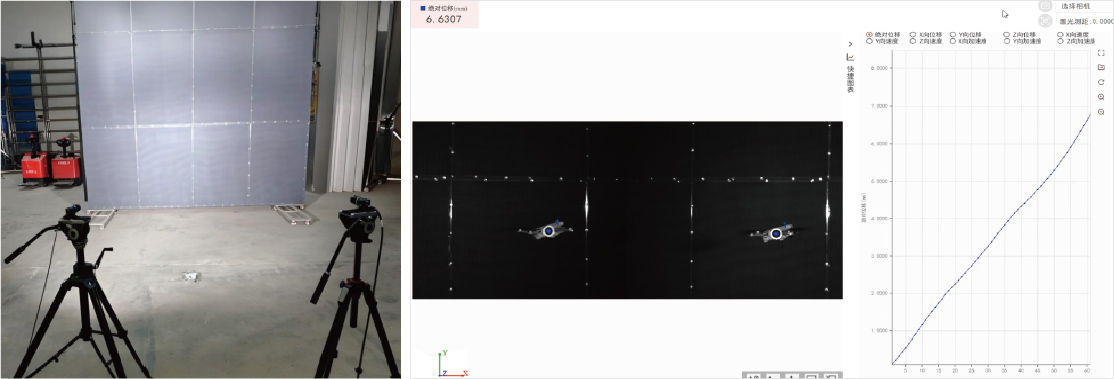
Haytham video extensometerBy identifying and tracking the marked points on the UAV body, position changes during flight can be continuously acquired. Based on the motion information of different marked points, the flight trajectory, direction of motion, displacement magnitude, and attitude changes of the UAV can be analyzed, and key maneuver phases can be recorded as data.
No cables need to be connected between the UAV and the measurement equipment during the test, which reduces the influence of contact measurement devices on the flight state. By synchronously tracking multiple marked points, the overall motion characteristics of the airframe during ascent, descent, turning, or vibration can also be determined, providing a basis for comparing different flight parameters and control strategies.
UAV dynamic tracking measurement can be used for flight control testing, airframe motion analysis, vibration testing, takeoff and landing process research, and control algorithm verification, and is also applicable to non-contact motion tracking of robots, mobile platforms, and other dynamic targets.





 Downloads

