Materials Mechanics
Monocular 3D Video Extensometer



Monocular 2D Optical Strain Measurement System
Monocular 3D Optical Strain Measurement System
High-Speed Monocular 3D Optical Strain Measurement System
Stereo 3D Optical Strain Measurement System
Optical Strain Measurement System – Educational Edition
2D Optical Microscopic Strain Measurement System


Strain Measurement of Parallel Lap Welds
Residual Deformation Measurement of Drilled Welded Plates
Full-Field Strain Measurement of Weldments in Compression
Tensile Deformation Measurement of 0.3mm Fiber Filament
Unmarked Compression Deformation Measurement of Composite Materials

Deformation Measurement of Artificial Cardiac Patch
Keycap Vibration Measurement: Quantifying Press and Rebound Dynamics
Headband Deformation Measurement: Analyzing Bending Position and Unloading Recovery
High-Temperature DIC Measurement of Wafer Thermal Warpage: Quantifying Warpage vs. Temperature
UAV Dynamic Tracking Measurement: Capturing Flight Trajectory and Attitude Changes

 0755-86347753

 PRODUCT
The 3D video extensometer is a non-contact extensometer based on monocular 3D DIC technology. The measurement head continuously captures images throughout the specimen loading process, while the software processes the images and outputs deformation results in real time. With the optional full-field measurement module, the system can also perform full-field displacement and strain measurements.


Class 0.5 Accuracy

Large Deformation Measurement

Automatic Target Recognition

Real-Time Measurement

Factory-Calibrated System

 Biaxial tensile testVideo extensometer
In biaxial tensile testing of composites, precisely measuring deformation under multiaxial stress is key to evaluating mechanical performance. Traditional methods often lack accuracy for complex composite stress states. Non-contact DIC measurement captures full-field strain across the whole specimen for dependable design data.
 Material shearDigital image correlation (DIC)
In materials testing, shear testing of aluminum alloy is essential for evaluating shear strength and ductility. Traditional approaches face insufficient accuracy, complex operation, and sensitivity to setup conditions. DIC-based non-contact measurement resolves these difficulties with accurate full-field strain data.
 Video extensometerWire tensile testing
Precision and stability are critical in tensile testing of fine wire. A wire of only 0.038mm diameter places extreme demands on the measurement equipment during loading. The Haytham monocular 3D video extensometer measures strain without contact or added load on the specimen, delivering stable, reliable results.
 Video extensometerRubber tensile testing
Measuring rubber strain under large deformation has long been a challenge in material testing. The Haytham monocular 3D video extensometer provides an efficient solution for large-deformation rubber tensile tests, capturing the full strain field without contact and staying accurate even at extreme elongation.
 Glass tensileVideo extensometer
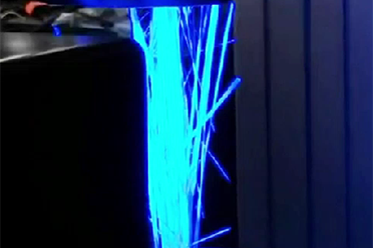
Glass fiber is widely used in aerospace, construction, and automotive fields for its light weight and high strength. To ensure reliability in real applications, testing its mechanical properties, especially tensile performance, is vital. DIC full-field strain measurement reveals the full tensile behavior of these specimens.
 Material compressionVideo extensometer
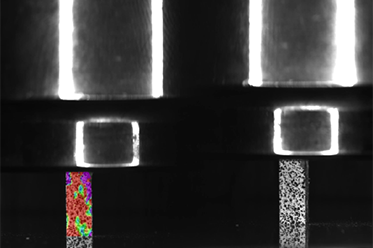
Silicon nitride column composite material is widely used in aerospace and electronics for its excellent high-temperature performance and mechanical strength. Its compression behavior is critical to stability and safety in service, so rigorous compression strain testing with accurate full-field data is essential for engineers.
 Composite buckling testingVideo extensometer
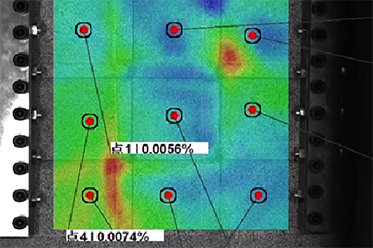
Composite materials are widely used in aerospace and automotive manufacturing for their high strength and low weight. However, in actual service they may buckle under compressive loads, affecting structural stability and safety. Buckling testing with DIC full-field measurement captures the onset and growth of buckling.
 Weld strength tensileFull-field strain measurement
Weld strength is a key indicator of weld quality. Conventional tensile testing usually captures strain only at specific points and cannot reveal the strain distribution across the weld area, while full-field strain testing measures the entire welded region during tension, giving engineers a complete picture of weld behavior.
 Cupping testVideo extensometer
The cupping test is a common formability test for metal materials, evaluating deep-drawing performance and local formability by measuring strain distribution and deformation as the material forms a cup under gradually increasing punch force. DIC full-field measurement supplies the detailed strain data traditional methods lack.
 DIC technologyShear testing
Compression-shear loading readily induces shear bands and local instability, and traditional methods struggle to capture the shear path. In titanium compression-shear testing, the Haytham video extensometer based on monocular 3D DIC technology stably outputs the shear-zone strain field evolution, supporting accurate analysis under combined loading.
 Shear stressVideo extensometer
Carbon fiber materials are widely used in aerospace, automotive, and sports equipment for their excellent mechanical properties and light weight. Shear performance directly affects the design and optimization of composite parts. This test captures full-field shear strain with non-contact DIC for solid material characterization data.
 Titanium-nickel alloy compression
TiNiNb titanium-nickel alloy specimens are small and prone to buckling, making fixture installation difficult and loading interference significant. The Haytham video extensometer, based on monocular 3D DIC technology, records strain evolution during axial compression without contact. This gives engineers stable compression data for small, buckling-prone specimens.
 Three-point bending testVideo extensometer
In three-point bending of prefabricated-notched metal specimens, the crack initiation zone is small and strain concentration pronounced, making crack-tip evolution hard to capture. The Haytham video extensometer, based on monocular 3D DIC technology, continuously observes strain near the crack tip for accurate analysis of crack initiation and propagation.
 Video extensometer3D full-field strain measurement
In compression testing of small alloy specimens, limited size and obvious end effects produce strongly non-uniform strain distributions. Contact extensometers or single-point methods cannot accurately reflect overall and local deformation behavior. Non-contact DIC delivers full-field strain throughout compression, giving engineers a complete view of specimen response.
 3D full-field strain measurementDIC technology
Aerogel foam has ultra-low density, high porosity, and strong non-uniformity, so compression brings local collapse and layer-by-layer compaction. Contact extensometers or single-point methods struggle to capture these mechanisms. Non-contact DIC captures full-field strain throughout compression, revealing deformation behavior in detail.
 3D full-field strain measurementThree-point bending test
In three-point bending tests of concrete specimens, the heterogeneous brittle material shows highly uneven strain, and cracks often initiate in the tension zone and spread rapidly. Traditional displacement meters or extensometers capture only midspan deflection or single points, while DIC provides full-field strain data.
 3D full-field strain measurementCrack propagation
In compression testing of concrete blocks, the loading process is accompanied by microcrack initiation, propagation, and coalescence, and the crack evolution path directly determines load capacity and failure mode. Traditional contact measurement yields only local data, while DIC tracks crack propagation across the surface.
 3D full-field strain measurementDIC technology
In soil tensile testing, the material is weak overall and loosely structured, so tension easily causes highly concentrated strain, fissure initiation, and rapid propagation, with three-dimensional, non-uniform failure. Traditional single-point methods give only isolated data, while 3D DIC delivers full-field strain measurement.
 Video extensometerMaterial tensile deformation measurement
In tensile testing of fiber filaments about 0.3mm in diameter, the slender, low-stiffness specimen slips or suffers shear damage in the clamping zone, and the short gauge length and small displacement defeat contact extensometers, which are hard to install and add constraint. Non-contact DIC avoids these problems for accurate deformation data.


 Downloads


