Materials Mechanics
Monocular 3D Video Extensometer



Monocular 2D Optical Strain Measurement System
Monocular 3D Optical Strain Measurement System
High-Speed Monocular 3D Optical Strain Measurement System
Stereo 3D Optical Strain Measurement System
Optical Strain Measurement System – Educational Edition
2D Optical Microscopic Strain Measurement System


Strain Measurement of Parallel Lap Welds
Residual Deformation Measurement of Drilled Welded Plates
Full-Field Strain Measurement of Weldments in Compression
Tensile Deformation Measurement of 0.3mm Fiber Filament
Unmarked Compression Deformation Measurement of Composite Materials

Deformation Measurement of Artificial Cardiac Patch
Keycap Vibration Measurement: Quantifying Press and Rebound Dynamics
Headband Deformation Measurement: Analyzing Bending Position and Unloading Recovery
High-Temperature DIC Measurement of Wafer Thermal Warpage: Quantifying Warpage vs. Temperature
UAV Dynamic Tracking Measurement: Capturing Flight Trajectory and Attitude Changes

 0755-86347753

 PRODUCT
The Monocular 3D Optical Strain Measurement System is a high-precision deformation measurement system based on monocular 3D DIC technology. Using only one camera, it provides accurate three-dimensional full-field displacement and strain measurements. The measurement head captures images throughout the specimen loading process, while the system automatically processes the images and outputs complete deformation results. It is easy to operate and delivers reliable performance.


High Repeatability

Strain Gauge Mode

Monocular 3D DIC

Standardized Measurement

 Digital image correlation (DIC)Tire compression strain
In automotive tire compression testing, accurately capturing tire deformation under load is essential for performance optimization and safety improvement. Traditional methods have many limitations and cannot fully reflect tire deformation behavior, making non-contact full-field DIC measurement a more complete choice.
 Vehicle frame displacementDigital image correlation (DIC)
In displacement testing of the automotive front subframe, measurement accuracy is critical. To verify it, the test team used a dial indicator with 0.001 precision and benchmarked the Haytham monocular 3D visual strain gauge against its displacement data, confirming DIC displacement accuracy for structural testing.
 DIC systemFatigue testing
Hip joint implants face complex multiaxial loads in the human body, including compression, tension, bending, and torsion. These superimposed loads make the fatigue behavior of the implant complex and difficult to predict. Traditional strain measurement relies on strain gauges, so non-contact DIC full-field measurement offers a more complete view of implant fatigue performance.
 DIC systemDigital image correlation (DIC)
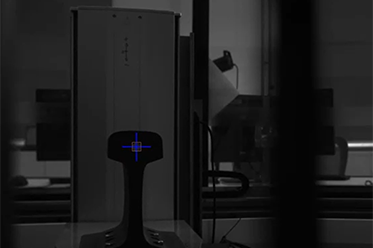
In some field testing tasks, the focus is on displacement results at key positions, together with high requirements for measurement stability and result consistency. This is especially true in complex, space-limited field environments, where dual-device single-point tracking provides stable, repeatable displacement data for the railway track.
 Digital image correlation (DIC)Virtual strain gauge
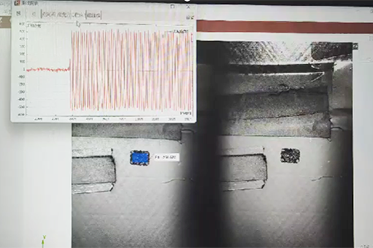
In fatigue life verification of propeller blades, traditional strain gauges are limited by difficult installation on curved surfaces, complex wiring, and signal degradation from long-term vibration, making comprehensive, stable measurement hard to achieve. The project team therefore adopted DIC full-field strain measurement.
 CAEDIC system
Composite materials are widely used in aerospace and automotive manufacturing for high strength and light weight. To optimize designs and ensure material reliability, engineers use computer-aided engineering (CAE) simulation to predict composite behavior, and DIC strain measurement validates simulation accuracy with real data.
 Vibration testingDIC system
As a key interior component, the automotive air conditioner control panel must withstand various vibration loads, so simulated vibration testing in development and production is essential to evaluate durability. Haytham monocular 3D DIC captures full-field panel strain under vibration for reliable durability assessment.
 DIC systemDigital image correlation (DIC)
As an important construction and structural material, log is significant in building engineering, making its mechanical properties vital to understand. Compression testing is a common method for evaluating compressive strength and deformation characteristics, while traditional contact strain gauges offer only point data.
 DIC systemDigital image correlation (DIC)
In the cement-filled steel pipe test, strain is a key indicator of how the material deforms under force, and for this composite structure the strain distribution is essential to structural safety. The Haytham monocular 3D visual strain gauge captures full-field strain of the pipe under load, supporting safety assessment.
 DIC digital image correlationMonocular 3D DIC technology
In loaded deformation measurement of steel structure components, the Haytham DIC visual strain gauge, using digital image correlation (DIC) technology, supports structural safety and performance optimization. Where traditional methods capture limited points, it delivers full-field deformation data under load.
 DIC systemDigital image correlation (DIC)
Under long-term repeated loading, fatigue damage gradually accumulates inside bridge slabs and may eventually lead to structural failure. Traditional fatigue testing methods rely on contact sensors that must be mounted directly on the slab surface, while DIC full-field strain measurement tracks the fatigue behavior of the whole surface without contact.
 DIC digital image correlationFatigue testing
Air springs are widely used in vehicle suspension systems and industrial equipment to provide cushioning and vibration reduction. Because they repeatedly bear dynamic loads in service, fatigue testing is a key step in evaluating their long-term performance. Traditional contact sensors offer limited coverage, so non-contact DIC reveals the deformation distribution throughout the fatigue test.
 DIC technologyFull-field strain measurement
Sports shoes are no longer simple footwear but a booster of athletic performance, so comfort, durability, and resistance to intense movement are major design challenges. DIC (digital image correlation) measures full-field strain non-intrusively during real loading, helping designers optimize materials and structures.
 Virtual strain gaugeStrength testing
Strain measurement is unavoidable in material and structural testing. Traditional resistance strain gauges are mature, but with complex geometries, non-uniform loads, or multi-region observation, bonding is tedious and wiring difficult. Virtual strain gauges based on DIC extract strain at any location without contact for fast, flexible multi-point observation.
 Cable bridge compressionDIC technology
Cable components in bridges have long spans and uncertain deformation modes, making multi-point strain gauge placement difficult. The Haytham visual strain gauge, based on monocular 3D DIC technology, sets multiple gauge sections and tracks them synchronously, capturing the multi-section response of bridge cables under compression loading.
 Virtual strain gaugeDICDigital image correlation
Strain measurement is critical in material mechanics and structural testing. Traditional resistance strain gauges are mature but fail when flexible materials resist bonding, structures are hard to wire, dynamic loading amplifies noise, and fixed points cannot be adjusted. DIC virtual measurement points overcome these limits.
 Rubber large deformationDIC technology
In large-deformation testing of rubber, strains often reach hundreds or thousands of percent, with nonlinearity, local concentration, and rebound. Contact extensometers slip or detach under such deformation, corrupting the data. Non-contact DIC tracks the specimen throughout for accurate full-field strain even at extreme elongation.


 Downloads


