Materials Mechanics
Monocular 3D Video Extensometer



Monocular 2D Optical Strain Measurement System
Monocular 3D Optical Strain Measurement System
High-Speed Monocular 3D Optical Strain Measurement System
Stereo 3D Optical Strain Measurement System
Optical Strain Measurement System – Educational Edition
2D Optical Microscopic Strain Measurement System


Strain Measurement of Parallel Lap Welds
Residual Deformation Measurement of Drilled Welded Plates
Full-Field Strain Measurement of Weldments in Compression
Tensile Deformation Measurement of 0.3mm Fiber Filament
Unmarked Compression Deformation Measurement of Composite Materials

Deformation Measurement of Artificial Cardiac Patch
Keycap Vibration Measurement: Quantifying Press and Rebound Dynamics
Headband Deformation Measurement: Analyzing Bending Position and Unloading Recovery
High-Temperature DIC Measurement of Wafer Thermal Warpage: Quantifying Warpage vs. Temperature
UAV Dynamic Tracking Measurement: Capturing Flight Trajectory and Attitude Changes

 0755-86347753

 Virtual strain gaugeDICDigital image correlation
In material mechanics and structural testing, strain measurement is always a critical step. Conventional resistance strain gauges are mature, but they are often constrained in scenarios such as flexible materials that are difficult to bond, wiring challenges on complex structures, noise amplification under dynamic loading, and measurement points that are hard to adjust once fixed. Research and engineering need not just data, but efficient, flexible, reliable, and repeatable solutions.
The virtual strain gaugeBased on digital image correlation (DIC) algorithms rather than a physical sensor. The system performs high-precision displacement/strain calculations on images before and after loading and generates "virtual measurement points" at any location on the specimen surface; strain and displacement results can be extracted in real time or in post-processing.
Core value:A single set of image data captured in one experiment supports multi-point reuse; even after the experiment is over, measurement points can be flexibly added on the same data to meet secondary and tertiary analysis needs.
Flexible and composite materials: tension/bending/interlaminar shear of films, honeycomb/sandwich structures, fabrics/prepregs, etc.
Complex structures and confined spaces: irregular components, welded/bonded zones, stiffener transition regions, and areas near holes/notches.
Dynamic and transient events: vibration, impact, rotation, collision, and fatigue crack initiation and propagation.
……
(1) Poisson's ratio test of composite materials
The front of the specimen was sprayed with a speckle pattern for DIC, and resistance strain gauges were bonded on the back for comparison; virtual strain gauges were placed in the images, corresponding one-to-one with the resistance strain gauge positions.
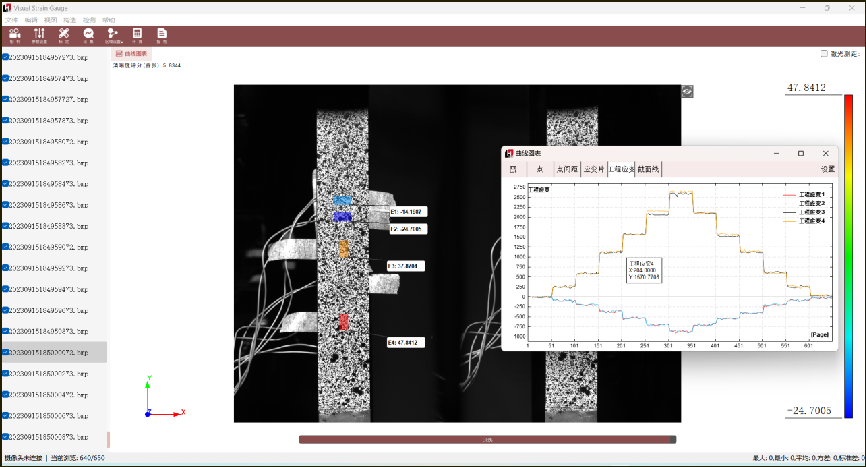
Results:The virtual strain gaugeThe computed Poisson's ratio agrees closely with the resistance strain gauges, and the further derived elastic modulus of ≈48 GPa matches the theoretical value of the material, verifying its reliability.
Calculation:Poisson's ratio = transverse strain / longitudinal strain
Value range:Take the average of the ratio over the 1500–2500 data range
2)Real-time vibration measurement
Under dynamic loading and vibration conditions, virtual strain gauges capture strain evolution in real time and reduce the noise amplification introduced by contact chains, providing stable support for high-speed and transient testing.
(3) Tensile comparison of composite plates
Comparing the virtual strain gauge with an adjacent resistance strain gauge: the two curves follow highly consistent trends, with fluctuations during the static loading stage within an acceptable range and a very small maximum deviation, accurately reflecting the evolution of the strain curve.
For tasks involving flexible materials, complex geometry, dynamic/high-speed loading, or measurement points that need repeated adjustment or traceability, virtual strain gauges offer clear advantages in efficiency, stability, and reusability. In many laboratory and engineering scenarios, Haytham virtual strain gauges can directly replace contact strain gauges as the preferred solution: faster preparation, more complete data, a more stable process, and a longer value cycle.
Q1: Do virtual strain gauges require bonded sensors?
A: No. A virtual strain gauge is a "virtual measurement point" computed from images, with no bonding or wiring required.
Q2: Can measurement points still be added after the experiment is over?
A: Yes. Virtual measurement points can be added or moved on the same image data at any time, supporting multiple rounds of recalculation and audit.
Q3: Is it suitable for dynamic/high-speed testing?
A: Yes. The system captures strain evolution in real time under conditions such as vibration and impact; image and mechanical data can be analyzed in sync.





 Downloads

