Materials Mechanics
Monocular 3D Video Extensometer



Monocular 2D Optical Strain Measurement System
Monocular 3D Optical Strain Measurement System
High-Speed Monocular 3D Optical Strain Measurement System
Stereo 3D Optical Strain Measurement System
Optical Strain Measurement System – Educational Edition
2D Optical Microscopic Strain Measurement System


Strain Measurement of Parallel Lap Welds
Residual Deformation Measurement of Drilled Welded Plates
Full-Field Strain Measurement of Weldments in Compression
Tensile Deformation Measurement of 0.3mm Fiber Filament
Unmarked Compression Deformation Measurement of Composite Materials

Deformation Measurement of Artificial Cardiac Patch
Keycap Vibration Measurement: Quantifying Press and Rebound Dynamics
Headband Deformation Measurement: Analyzing Bending Position and Unloading Recovery
High-Temperature DIC Measurement of Wafer Thermal Warpage: Quantifying Warpage vs. Temperature
UAV Dynamic Tracking Measurement: Capturing Flight Trajectory and Attitude Changes

 0755-86347753

 DIC vibration measurementNon-contact displacement measurement
The pressing feel of a keycap depends not only on the actuation travel and pressing force but also on the structural stiffness, rebound speed, and vibration characteristics of the keycap. For lightweight, small-sized keycaps, installing contact sensors may alter their original mass and dynamic response, so a non-contact approach is required to obtain true motion data.
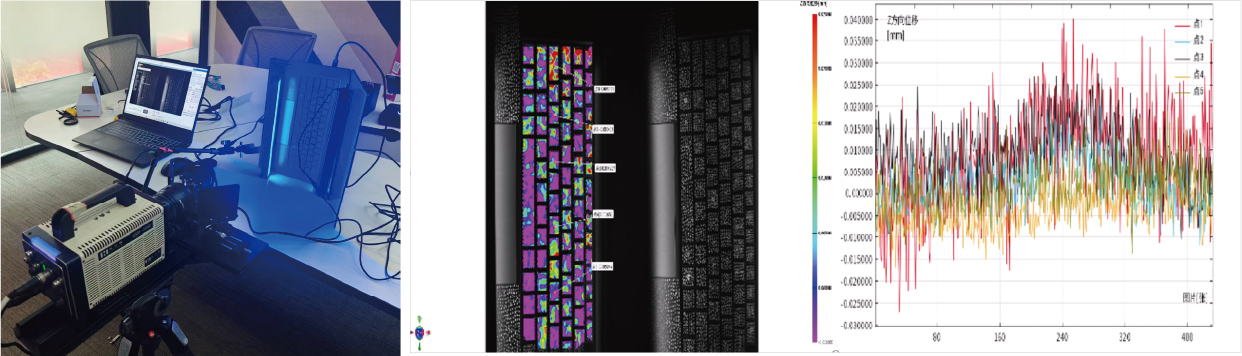
Haytham monocular 3D high-speed visual strain gaugeUsing monocular 3D DIC digital image correlation technology with high-speed image acquisition, the pressing, bottoming-out, rebound, and residual vibration of the keycap at the moment of a keystroke are completely recorded. The system can acquire the 3D displacement, motion trajectory, and vibration response at different positions on the keycap surface, and analyze the maximum press depth, rebound time, local deformation differences, and vibration decay patterns.
Compared with recording only single-point displacement, keycap vibration measurement presents the overall motion state of the keycap and identifies problems such as tilted pressing, local deformation, or uneven rebound, converting the subjective "feel experience" into comparable and analyzable quantitative data.
This method can be used for testing laptop keyboards, mechanical keyboards, membrane keys, and other precision key structures, providing data support for keycap structure design, material selection, feel optimization, and reliability verification.





 Downloads

