Materials Mechanics
Monocular 3D Video Extensometer



Monocular 2D Optical Strain Measurement System
Monocular 3D Optical Strain Measurement System
High-Speed Monocular 3D Optical Strain Measurement System
Stereo 3D Optical Strain Measurement System
Optical Strain Measurement System – Educational Edition
2D Optical Microscopic Strain Measurement System


Strain Measurement of Parallel Lap Welds
Residual Deformation Measurement of Drilled Welded Plates
Full-Field Strain Measurement of Weldments in Compression
Tensile Deformation Measurement of 0.3mm Fiber Filament
Unmarked Compression Deformation Measurement of Composite Materials

Deformation Measurement of Artificial Cardiac Patch
Keycap Vibration Measurement: Quantifying Press and Rebound Dynamics
Headband Deformation Measurement: Analyzing Bending Position and Unloading Recovery
High-Temperature DIC Measurement of Wafer Thermal Warpage: Quantifying Warpage vs. Temperature
UAV Dynamic Tracking Measurement: Capturing Flight Trajectory and Attitude Changes

 0755-86347753

 Virtual strain gaugeStrength testing
Strain measurement is an unavoidable part of material and structural testing. Although conventional resistance strain gauges are mature and widely used, in typical scenarios involving complex geometries, non-uniform loads, and multi-zone strain observation, tedious bonding, difficult wiring, and fixed measurement points often constrain testing efficiency and analysis depth — a constant headache for engineers.
To break through the limitations of conventional methods, Haytham has introduced the virtual strain gauge — a new strain extraction approach requiring no bonding, with flexible measurement points and post-processing support. Its results deviate from resistance strain gauges by no more than 50 με, and it is increasingly used by research teams for critical testing tasks, gradually replacing some functions of resistance strain gauges.
The virtual strain gauge is a software feature that computes local strain through image analysis, essentially derived from high-precision processing of deformed images. It is not a physical sensor: relying on an optimized digital image correlation (DIC) algorithm, it uses load input and image acquisition to compute and reconstruct strain and displacement data at any location on the specimen surface, and results can be exported for any measurement point. Its core advantages:
• Greater measurement freedom:no bonding or wiring needed; define measurement zones anywhere;
• Deeper analysis:delivers high-density local strain distribution data to easily capture failure mechanisms;
• Greater efficiency:simplifies preparation, reduces manual intervention and equipment setup burden, and improves overall testing efficiency;
• More faithful testing:in static structural stiffness testing, sensors and cables add extra load to the test object; the virtual strain gauge adds none, more faithfully reproducing the deformation process of the structure under its own weight.
• Real-time mode: read strain data for preset zones directly during loading — load, analyze, and feed back simultaneously. Suitable for fatigue testing, dynamic evaluation, strain-rate control, and other scenarios requiring online monitoring.
• Post-processing mode: after the test, users can flexibly adjust measurement point positions and ranges, with repeated comparison and verification of key zones to raise the value of the data. Suitable for data-driven scenarios such as parameter extraction, CAE validation, and detail analysis.
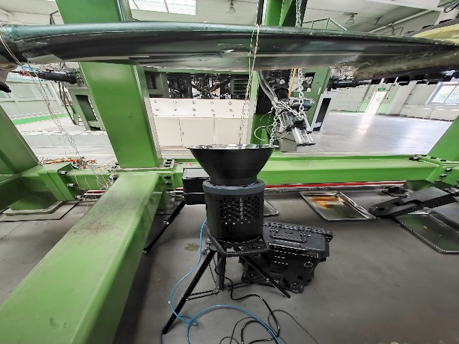
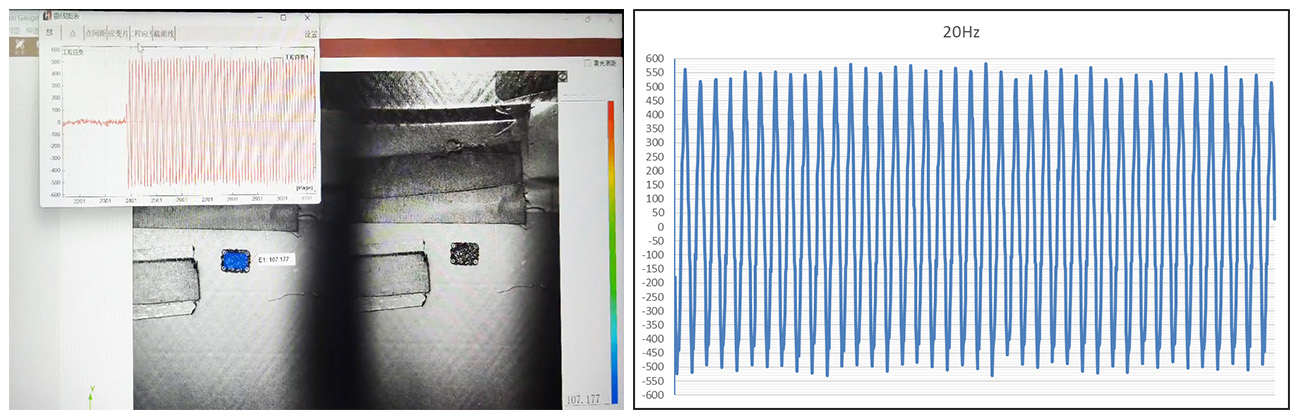
Example 1: Propeller blade fatigue test
Continuously measures strain at key points on the propeller blade under dynamic fatigue loads, replacing resistance strain gauges for fatigue life assessment. The visual approach greatly reduces test preparation time and raises the automation and digitalization of the test process.
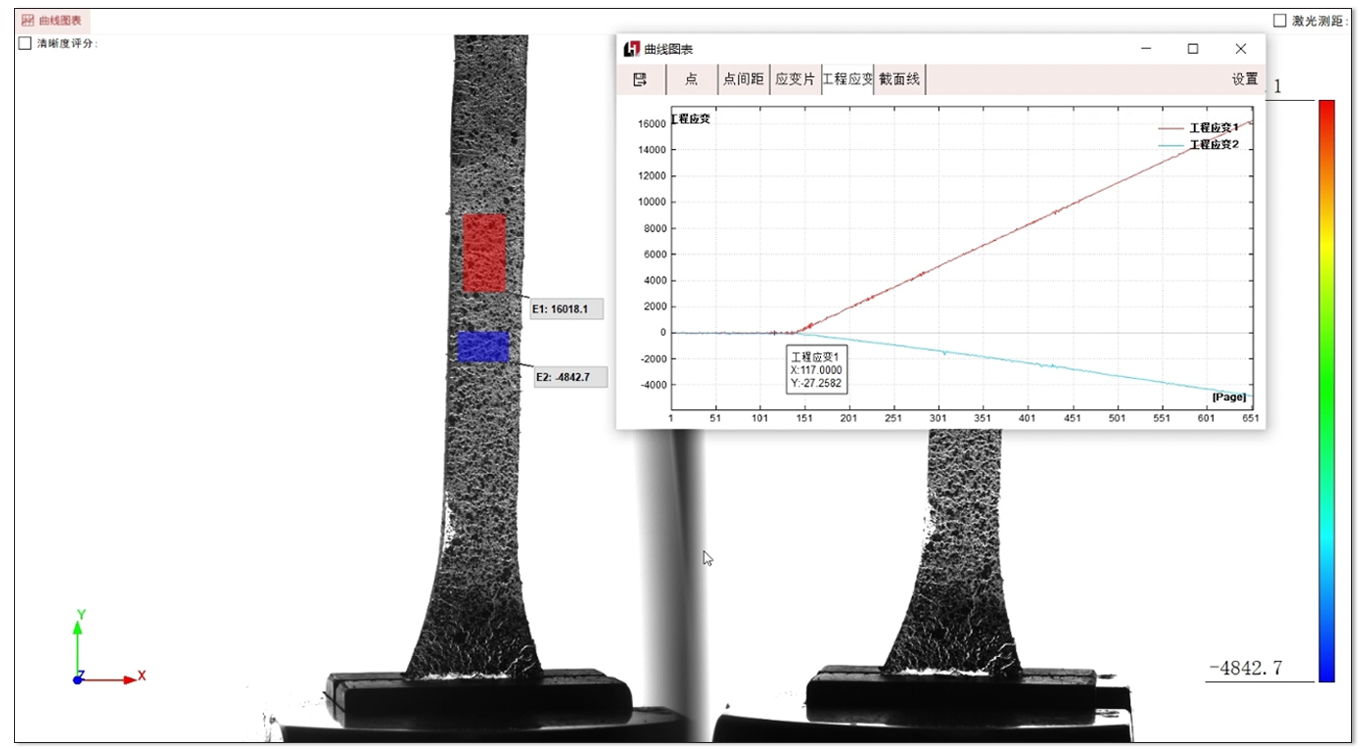
Example 2: Hydrogel Poisson's ratio test
For flexible materials that cannot carry bonded sensors, the post-processing mode precisely extracts key strain data, avoiding bonding errors and improving experimental repeatability and fidelity.
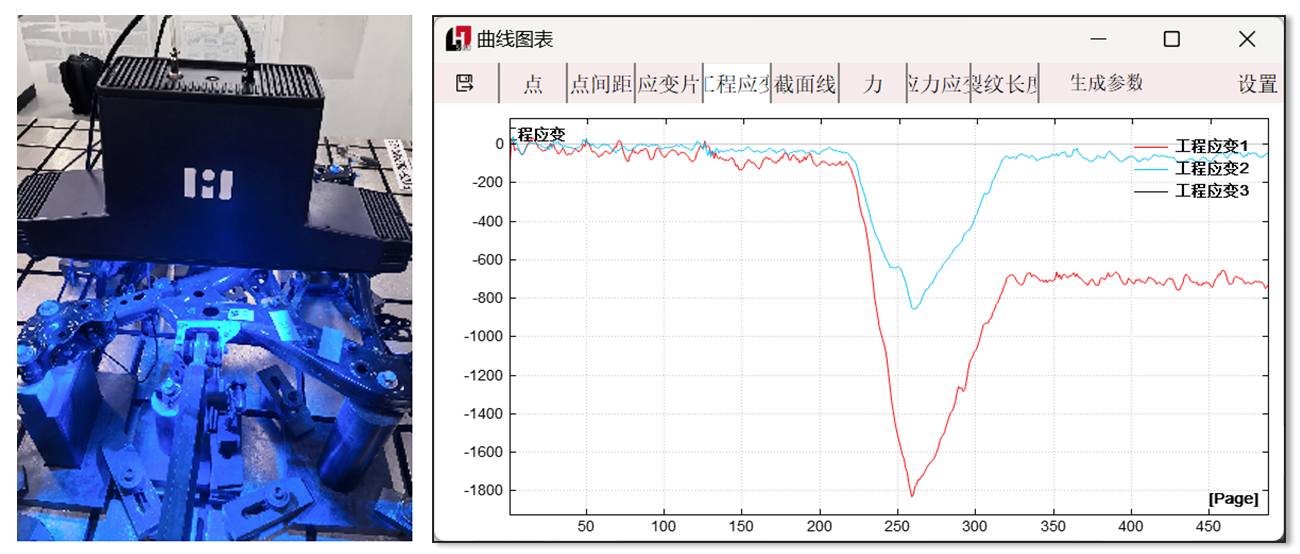
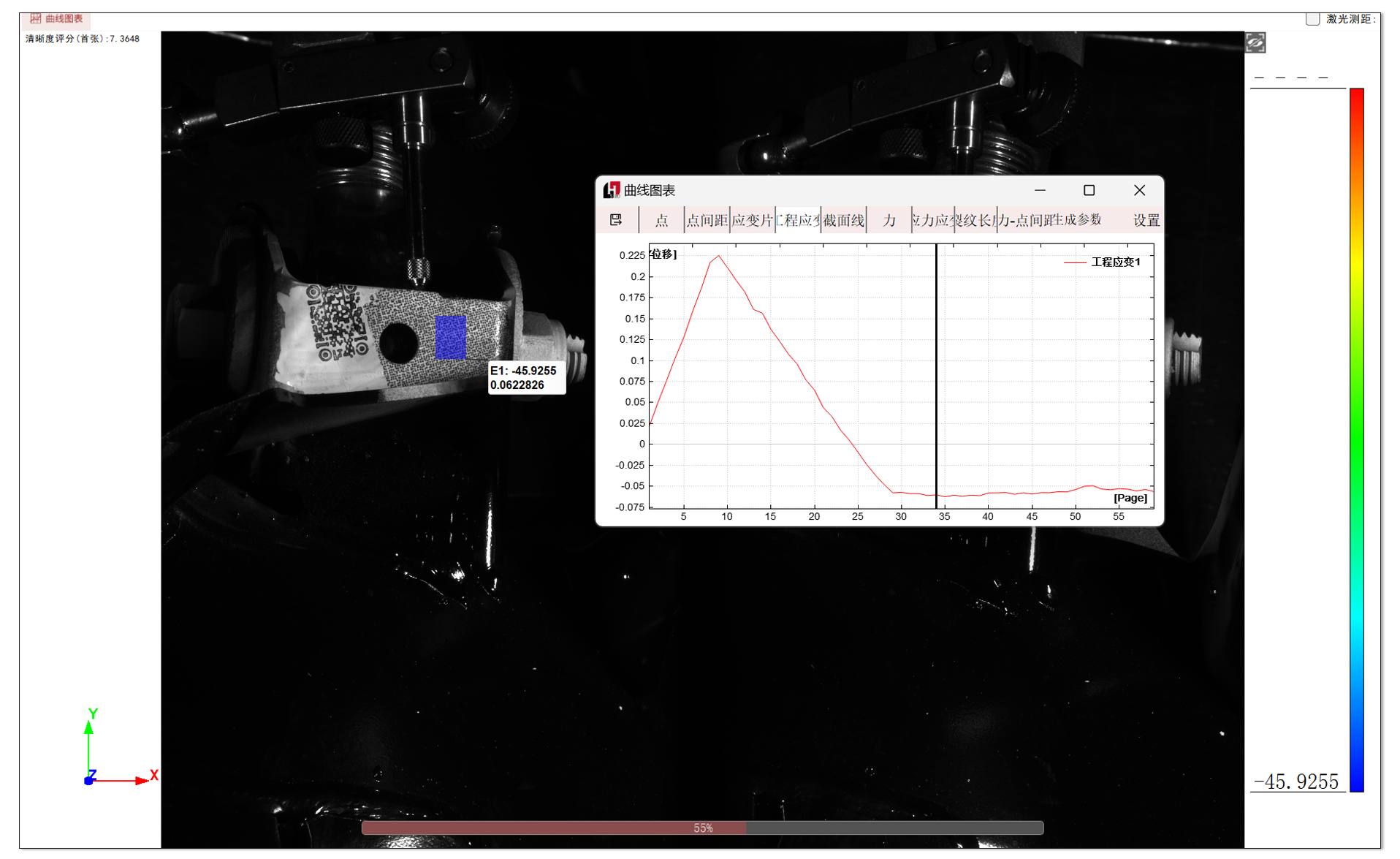
Example 3: Local strain evaluation of an automotive front subframe
On a front subframe too complex and space-constrained for strain gauges, weld seams and weak spots are monitored in real time, supporting durability design and local reinforcement decisions.
Example 4: Automotive front subframe displacement measurement
The virtual strain gaugeIt also enables real-time 3D displacement measurement. In a front subframe vibration test at a 14.7 kN applied load, the virtual strain gauge measured a Z-direction displacement of 0.053 mm, in close agreement with the 0.05 mm dial gauge reading.


 Downloads

