Materials Mechanics
Monocular 3D Video Extensometer



Monocular 2D Optical Strain Measurement System
Monocular 3D Optical Strain Measurement System
High-Speed Monocular 3D Optical Strain Measurement System
Stereo 3D Optical Strain Measurement System
Optical Strain Measurement System – Educational Edition
2D Optical Microscopic Strain Measurement System


Strain Measurement of Parallel Lap Welds
Residual Deformation Measurement of Drilled Welded Plates
Full-Field Strain Measurement of Weldments in Compression
Tensile Deformation Measurement of 0.3mm Fiber Filament
Unmarked Compression Deformation Measurement of Composite Materials

Deformation Measurement of Artificial Cardiac Patch
Keycap Vibration Measurement: Quantifying Press and Rebound Dynamics
Headband Deformation Measurement: Analyzing Bending Position and Unloading Recovery
High-Temperature DIC Measurement of Wafer Thermal Warpage: Quantifying Warpage vs. Temperature
UAV Dynamic Tracking Measurement: Capturing Flight Trajectory and Attitude Changes

 0755-86347753

Published: 2024-08-05
Digital image correlation (DIC) is a non-contact strain measurement technology based on image analysis. Compared with traditional mechanical property measurement methods, DIC has significant advantages in non-contact operation, full-field strain measurement, adaptation to complex geometries and real-time dynamic measurement. These features have made DIC widely used in complex stress states, material characterization, structural health monitoring and other fields.
1. Non-contact measurement
DIC obtains strain information by capturing images of the specimen surface, without physical contact, so it has no effect on the specimen. Compared with traditional contact methods such as strain gauges, DIC can measure the strain of sensitive or fragile materials without damaging them.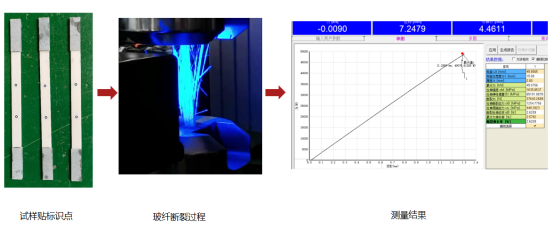
Tensile test of glass fiber materials
2. Full-field strain measurement
DIC can provide the strain distribution over the entire specimen surface, while traditional methods usually measure only local areas or single points. Full-field measurement has significant advantages for analyzing material behavior under complex stress states, especially in studying fracture and crack propagation.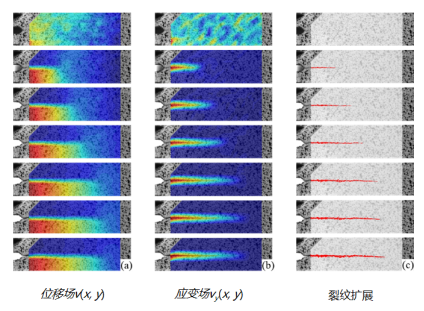
3. Adaptable to Complex Geometric Structures
DIC can be applied to the measurement of various complex geometric structures without requiring the specific surface treatment or geometric constraints of traditional measurement methods. Therefore, DIC is more flexible in practical engineering applications.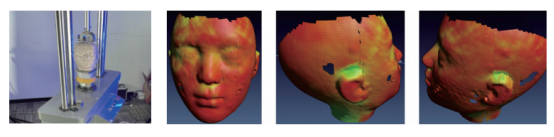
360° full-field strain measurement
4. High resolution
Thanks to high-resolution cameras, DIC can capture tiny displacement and strain changes with very high spatial resolution. This enables DIC to detect local deformation in microscopic structures, suitable for micro-scale and nano-scale research.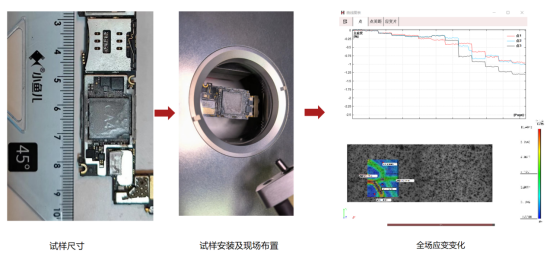
Low-temperature deformation test of a mobile phone chip (temperature change from 20℃ to -190℃, cracking at -160℃)
5. Real-time dynamic measurement
DIC can perform real-time dynamic measurement, suitable for capturing rapidly changing stress-strain states, such as the transient response of materials under impact loads. This is usually hard to achieve with traditional methods or would require complex sensor networks.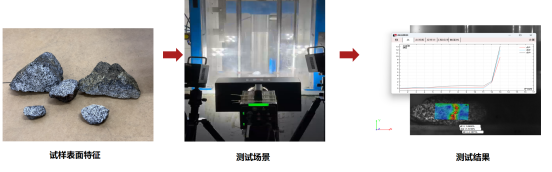
Pyrite drop hammer impact test
6. Multi-dimensional measurement
DIC can measure not only in-plane strain but also 3D displacement and strain through multi-camera systems. This is very useful when studying the 3D strain field of materials under complex loads.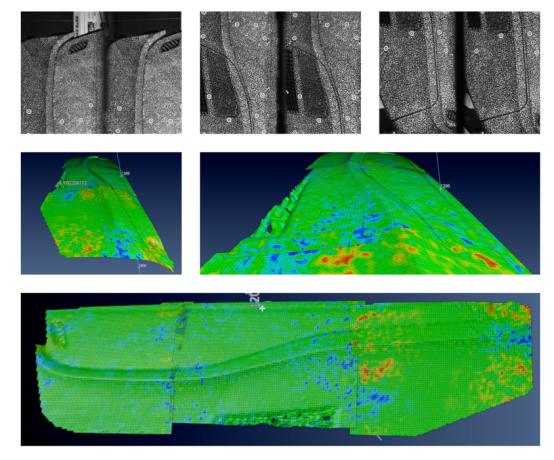
Automotive dashboard stiffness test — multi-camera multi-angle data stitching
7. Easy to Set Up and Apply
Compared with some traditional measurement methods, the experimental setup of DIC is relatively simple, requiring no complex sensor arrangement or special surface treatment. Measurement can be performed simply by spraying a random pattern on the specimen surface or using natural texture.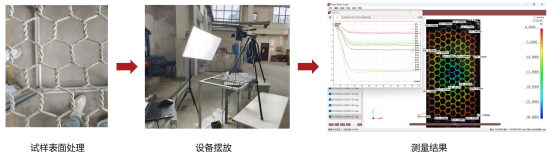
Fishing net loading deformation analysis





 Downloads

