Materials Mechanics
Monocular 3D Video Extensometer



Monocular 2D Optical Strain Measurement System
Monocular 3D Optical Strain Measurement System
High-Speed Monocular 3D Optical Strain Measurement System
Stereo 3D Optical Strain Measurement System
Optical Strain Measurement System – Educational Edition
2D Optical Microscopic Strain Measurement System


Strain Measurement of Parallel Lap Welds
Residual Deformation Measurement of Drilled Welded Plates
Full-Field Strain Measurement of Weldments in Compression
Tensile Deformation Measurement of 0.3mm Fiber Filament
Unmarked Compression Deformation Measurement of Composite Materials

Deformation Measurement of Artificial Cardiac Patch
Keycap Vibration Measurement: Quantifying Press and Rebound Dynamics
Headband Deformation Measurement: Analyzing Bending Position and Unloading Recovery
High-Temperature DIC Measurement of Wafer Thermal Warpage: Quantifying Warpage vs. Temperature
UAV Dynamic Tracking Measurement: Capturing Flight Trajectory and Attitude Changes

 0755-86347753

Published: 2026-06-29
In material testing, both traditional contact extensometers and single-camera DIC video extensometers can measure strain, but they differ significantly in measurement method, applicable scenarios and user experience.
Traditional extensometers usually need to clamp on the specimen surface, sensing gauge length changes through mechanical structures. This approach is widely used in standard metal specimen testing, but for thin sheets, soft materials, composites, rubber, plastics and high/low-temperature environment testing, clamping force, installation position and sensor weight may all affect the specimen deformation results.
Haytham video extensometerUsing single-camera DIC digital image correlation technology, no specimen contact is needed. The device captures specimen surface images through a camera, recognizes the displacement changes of markers or speckle areas, and computes strain data via algorithms. Without mechanical clamping, testing is more convenient and specimen interference is reduced.
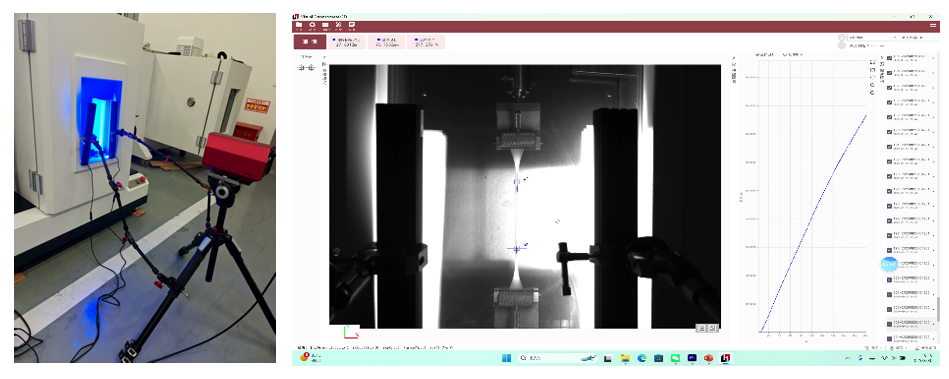
Large-deformation tensile experiment of rubber material at 120℃
In large-deformation testing, traditional extensometers may be limited by range and can hardly record the whole process from the elastic stage to large deformation. The video extensometer continuously tracks gauge length changes through images, suitable for a wider range of strain measurement. For specimens with high fracture risk, it also avoids the falling off, damage or fracture morphology influence of contact extensometers.
In high- or low-temperature testing,video extensometer also has advantages. The device can be placed outside the furnace or low-temperature chamber, capturing images through the observation window to achieve long-distance non-contact measurement, reducing the influence of high/low-temperature environments on the sensor itself.
If the test object is a conventional metal specimen, traditional extensometers still have application value; but if the test involves large deformation, non-standard specimens, complex environments or high requirements for test process visualization, the Haytham single-camera DIC video extensometer is more flexible and intuitive.





 Downloads

