Materials Mechanics
Monocular 3D Video Extensometer



Monocular 2D Optical Strain Measurement System
Monocular 3D Optical Strain Measurement System
High-Speed Monocular 3D Optical Strain Measurement System
Stereo 3D Optical Strain Measurement System
Optical Strain Measurement System – Educational Edition
2D Optical Microscopic Strain Measurement System


Strain Measurement of Parallel Lap Welds
Residual Deformation Measurement of Drilled Welded Plates
Full-Field Strain Measurement of Weldments in Compression
Tensile Deformation Measurement of 0.3mm Fiber Filament
Unmarked Compression Deformation Measurement of Composite Materials

Deformation Measurement of Artificial Cardiac Patch
Keycap Vibration Measurement: Quantifying Press and Rebound Dynamics
Headband Deformation Measurement: Analyzing Bending Position and Unloading Recovery
High-Temperature DIC Measurement of Wafer Thermal Warpage: Quantifying Warpage vs. Temperature
UAV Dynamic Tracking Measurement: Capturing Flight Trajectory and Attitude Changes

 0755-86347753

 High-temperature extensometerHigh-temperature compression test
In the field of materials science, composite materials are widely used in aerospace and energy, especially in extreme high-temperature environments, thanks to their excellent strength and heat resistance. To ensure the reliability of these materials in practical applications, their mechanical properties under extreme conditions must be rigorously tested. Conducting compression testing of composite materials in the ultra-high-temperature environment of 2300°C challenges not only the specimen material itself but also places extremely high demands on the accuracy and heat resistance of the testing equipment.
1. Testing Challenges
Conventional extensometer measurement techniques usually rely on placing marking points on the specimen surface to capture deformation. However, at the extreme temperature of 2300°C, any physical marking point may volatilize or burn out due to the high temperature, or fall off due to drastic changes on the material surface, making it difficult for traditional methods to obtain reliable deformation data. In addition, placing marking points may interfere with the specimen's natural deformation behavior and affect the accuracy of the test results.
2. Innovative Application of the Haytham Monocular 2D High-Temperature Video Extensometer
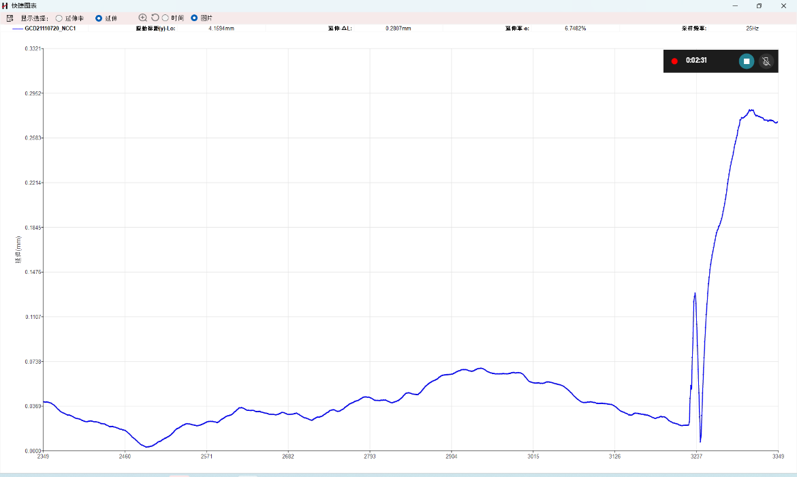
To solve this problem, the Haytham monocular 2D high-temperature video extensometer adopts laser speckle technology. This technique requires no marking points on the specimen surface; instead, a laser irradiates the specimen surface to produce natural speckle patterns. These patterns change as the specimen deforms, and the video extensometer measures the specimen's deformation by capturing and analyzing the displacement of the speckle patterns. Even under the extreme high-temperature condition of 2300°C, this technology still delivers stable and accurate measurement results.

Measurement setup of the Haytham monocular 2D high-temperature video extensometer
3. Experimental Procedure
In the test, the composite specimen was mounted in a high-temperature compression testing machine and gradually heated to 2300°C. Since conventional marking points cannot be used at such extreme temperatures, the Haytham monocular 2D high-temperature video extensometer employed laser speckle technology to perform non-contact measurement of the specimen surface. As the compressive force was applied, the speckle patterns on the specimen surface shifted; the video extensometer captured these changes in real time and calculated the specimen's deformation with high-precision algorithms.
4. Test Results
Using laser speckle technology, researchers successfully obtained compression stress-strain data of composite materials in the ultra-high-temperature environment of 2300°C. These data provide a valuable reference for understanding the mechanical properties of composites under extreme conditions; notably, accurate and repeatable test results were achieved even without any marking points.
5. Application Significance
The successful application of the Haytham monocular 2D high-temperature video extensometer in 2300°C compression testing of composite materials demonstrates the unique advantages of laser speckle technology for measurement under extreme conditions. Breaking through the limitations of traditional methods, this technique provides accurate measurement data in high-temperature environments without interfering with the specimen's natural behavior. As materials science research continues to deepen, this technology will play an important role in more high-temperature experiments, providing solid technical support for the development and validation of high-performance materials.





 Downloads

