Materials Mechanics
Monocular 3D Video Extensometer



Monocular 2D Optical Strain Measurement System
Monocular 3D Optical Strain Measurement System
High-Speed Monocular 3D Optical Strain Measurement System
Stereo 3D Optical Strain Measurement System
Optical Strain Measurement System – Educational Edition
2D Optical Microscopic Strain Measurement System


Strain Measurement of Parallel Lap Welds
Residual Deformation Measurement of Drilled Welded Plates
Full-Field Strain Measurement of Weldments in Compression
Tensile Deformation Measurement of 0.3mm Fiber Filament
Unmarked Compression Deformation Measurement of Composite Materials

Deformation Measurement of Artificial Cardiac Patch
Keycap Vibration Measurement: Quantifying Press and Rebound Dynamics
Headband Deformation Measurement: Analyzing Bending Position and Unloading Recovery
High-Temperature DIC Measurement of Wafer Thermal Warpage: Quantifying Warpage vs. Temperature
UAV Dynamic Tracking Measurement: Capturing Flight Trajectory and Attitude Changes

 0755-86347753

 Reduction of area2D video extensometer
The reduction of area and elongation after fracture of a material are important indicators of its toughness and ductility. In tensile testing, these two parameters are essential for evaluating the material's performance in practical applications. Traditional measurement methods usually rely on manual measurement or a single-direction extensometer, but these approaches have limitations in accuracy and efficiency, especially when testing materials with complex shapes or anisotropic behavior. To address this problem, the Haytham monocular 2D video extensometer provides a more comprehensive and precise measurement solution.
1. Testing Challenges
Measuring the reduction of area requires precisely measuring the cross-sectional dimensions of the specimen before and after fracture, while measuring the elongation after fracture requires obtaining the specimen's longitudinal elongation after fracture. Single-direction measurement in traditional methods may overlook the specimen's transverse deformation, resulting in incomplete measurement data. Moreover, the inevitable errors of manual operation make precise measurement of these parameters even more challenging.
2. Application of the Haytham Monocular 2D Video Extensometer
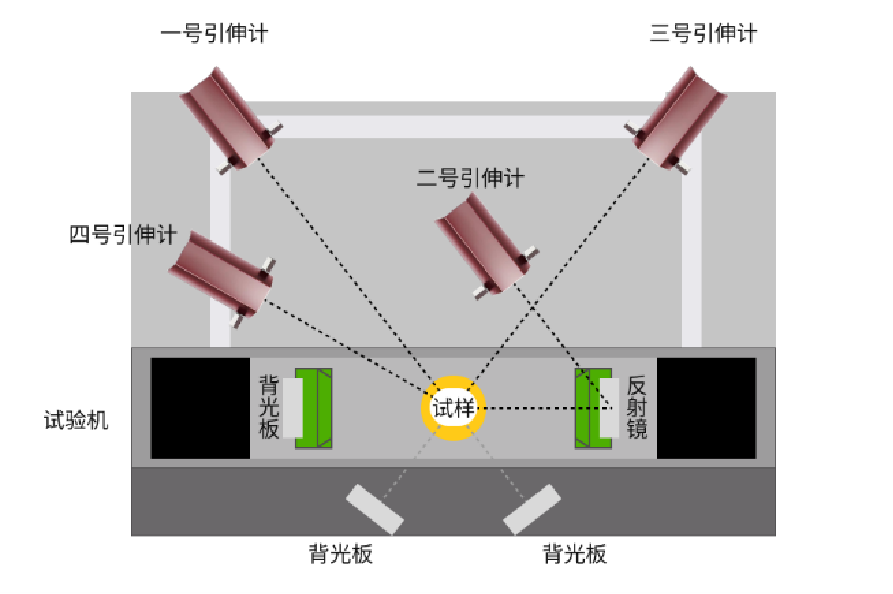
To obtain more accurate and comprehensive measurement data, three Haytham monocular 2D extensometers of the same model were used in the test to synchronously collect the specimen's width data from different orientations (extensometers No. 1, No. 2, and No. 3 in the figure below). This configuration captures the specimen's transverse deformation in all directions in real time during tension, providing multi-dimensional data support for calculating the reduction of area.
Meanwhile, to measure the elongation after fracture, another Haytham monocular 2D extensometer was used to collect the specimen's longitudinal elongation data (extensometer No. 4 in the figure below). With its high-precision image analysis capability, this extensometer can accurately measure the specimen's total deformation after being stretched to fracture, providing a reliable basis for calculating the elongation after fracture.
3. Experimental Procedure
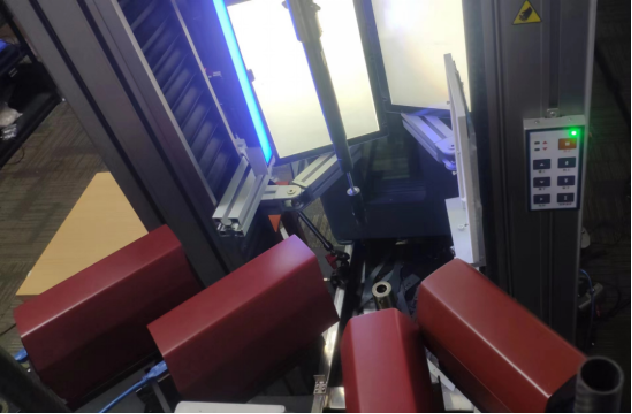
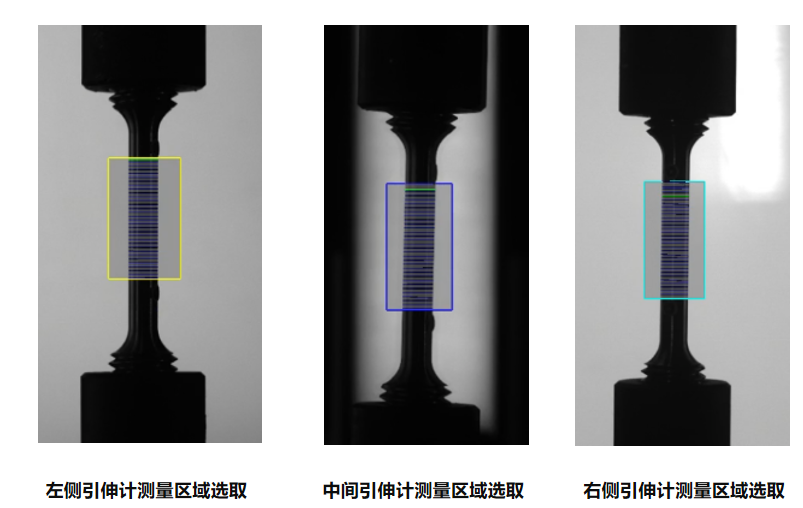
At the start of the test, the specimen was mounted in a tensile testing machine. Three Haytham monocular 2D video extensometers were installed at three different orientations around the specimen, capturing deformation data in the width direction in real time. When the specimen was stretched to fracture, the multi-orientation deformation data captured by these extensometers were aggregated and used to calculate the reduction of area.
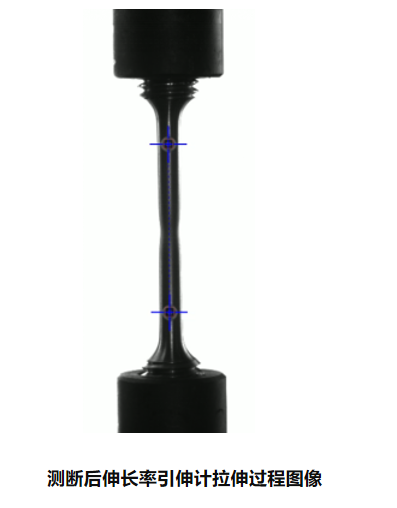
Subsequently, the fourth extensometer was used to measure the specimen's longitudinal elongation after fracture. By tracking feature points on the specimen surface, this extensometer precisely measured the elongation data after fracture and, combined with the initial length data, calculated the elongation after fracture.
4. Test Results
Through this multi-extensometer synchronous measurement approach, researchers obtained more accurate reduction-of-area and elongation-after-fracture data. The multi-orientation data acquisition made the reduction-of-area measurement more comprehensive, avoiding the data bias that traditional single-direction measurement may cause. The elongation-after-fracture results demonstrate the significant advantage of the Haytham monocular 2D video extensometer in high-precision non-contact measurement.
Reduction of area measurement
Elongation after fracture measurement
5. Application Significance
The application of the Haytham monocular 2D video extensometer in measuring reduction of area and elongation after fracture demonstrates its powerful capabilities in testing complex materials. Through multi-orientation synchronous measurement and high-precision data acquisition, the system significantly improves testing accuracy and reliability. In the future, this technology is expected to be more widely applied in materials science, engineering testing, quality control, and other fields, providing important technical support for the research and development of high-performance materials.





 Downloads

