Materials Mechanics
Monocular 3D Video Extensometer



Monocular 2D Optical Strain Measurement System
Monocular 3D Optical Strain Measurement System
High-Speed Monocular 3D Optical Strain Measurement System
Stereo 3D Optical Strain Measurement System
Optical Strain Measurement System – Educational Edition
2D Optical Microscopic Strain Measurement System


Strain Measurement of Parallel Lap Welds
Residual Deformation Measurement of Drilled Welded Plates
Full-Field Strain Measurement of Weldments in Compression
Tensile Deformation Measurement of 0.3mm Fiber Filament
Unmarked Compression Deformation Measurement of Composite Materials

Deformation Measurement of Artificial Cardiac Patch
Keycap Vibration Measurement: Quantifying Press and Rebound Dynamics
Headband Deformation Measurement: Analyzing Bending Position and Unloading Recovery
High-Temperature DIC Measurement of Wafer Thermal Warpage: Quantifying Warpage vs. Temperature
UAV Dynamic Tracking Measurement: Capturing Flight Trajectory and Attitude Changes

 0755-86347753

 Material strainHigh-cycle fatigue
In high-cycle fatigue testing of metal materials, fatigue performance directly affects the reliability of structural components under long-term repeated loading. However, when performing high-cycle fatigue testing, conventional DIC systems usually need to acquire more than 10 images within a single fatigue cycle, placing extremely high demands on the sampling frequency of the measurement head. For fatigue tests involving tens of thousands of cycles, this not only occupies a large amount of hard disk storage space but also easily causes problems such as data delays and system crashes. To address these challenges, the Haytham monocular 2D video extensometer, with an integrated fatigue measurement module, provides an efficient and reliable solution.
1. Testing Challenges
In high-cycle fatigue testing, conventional DIC systems acquire at high frequencies and produce huge data volumes, overloading the system. Tens of thousands of high-frequency image captures and data records not only occupy enormous storage space but may also cause data delays or system crashes due to hardware or software limitations. In addition, since the deformation within each fatigue cycle is tiny, acquiring too much data can increase noise and actually compromise the accuracy of the analysis results.
2. Innovative Application of the Haytham Monocular 2D Video Extensometer
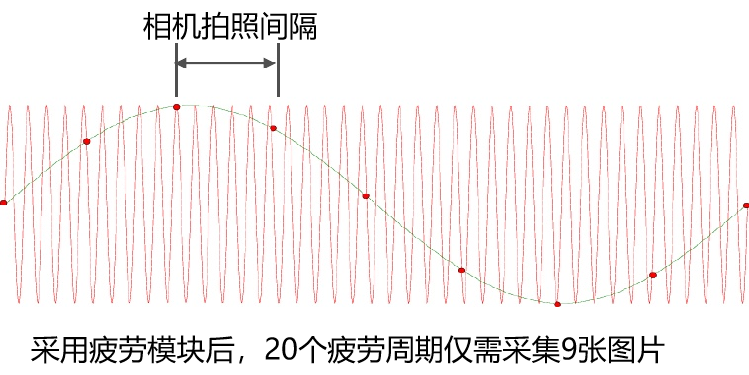
To solve the above problems, the Haytham monocular 2D video extensometer is equipped with a dedicated fatigue measurement module which, working in coordination with the controller and software, fits the N small cycles in a high-cycle fatigue test into 1 large cycle. This method effectively reduces the amount of data acquired within each fatigue cycle, while cross-cycle image acquisition ensures that the DIC system can track the specimen's deformation process throughout the test.
This innovative acquisition method enables the system to drastically reduce the data volume without sacrificing measurement accuracy. This not only lowers storage requirements but also avoids delays and system crashes during data processing. Meanwhile, through the large-cycle fitting, the DIC system can more precisely capture the key deformation characteristics of the material during high-cycle fatigue loading.

3. Experimental Procedure
In high-cycle fatigue testing of metal materials, the specimen is mounted on a fatigue testing machine, and the Haytham monocular 2D video extensometer monitors the specimen surface in real time. With the fatigue measurement module configured, the system fits the data of N small fatigue cycles into one large cycle, triggering the DIC system to capture images across cycles at key moments. The image data acquired each time are processed and stored promptly, while the controller and software track and analyze the data throughout the entire process.

10 Hz fatigue loading

Real-time deformation calculation by the Haytham DIC system
4. Test Results
With this optimized acquisition scheme, the image data volume in high-cycle fatigue testing was significantly reduced in the test, lowering hard disk storage requirements. In addition, the system ran more stably, with no data delays or crashes. Most importantly, despite the reduced acquisition volume, the material's deformation characteristics during the fatigue test were still captured accurately, and the N-value and R-value measurement results showed high reliability and consistency.
5. Application Significance
The application of the Haytham monocular 2D video extensometer in high-cycle fatigue testing of metal materials demonstrates its outstanding performance in efficient data acquisition and precise deformation monitoring. With the fatigue measurement module, the system not only overcomes the data volume and storage space challenges of conventional DIC technology in high-cycle fatigue testing but also improves measurement accuracy and system stability. This case provides a better technical path for testing the fatigue properties of materials and offers important insights for scientific research and industrial applications in related fields.


 Downloads

