Materials Mechanics
Monocular 3D Video Extensometer



Monocular 2D Optical Strain Measurement System
Monocular 3D Optical Strain Measurement System
High-Speed Monocular 3D Optical Strain Measurement System
Stereo 3D Optical Strain Measurement System
Optical Strain Measurement System – Educational Edition
2D Optical Microscopic Strain Measurement System


Strain Measurement of Parallel Lap Welds
Residual Deformation Measurement of Drilled Welded Plates
Full-Field Strain Measurement of Weldments in Compression
Tensile Deformation Measurement of 0.3mm Fiber Filament
Unmarked Compression Deformation Measurement of Composite Materials

Deformation Measurement of Artificial Cardiac Patch
Keycap Vibration Measurement: Quantifying Press and Rebound Dynamics
Headband Deformation Measurement: Analyzing Bending Position and Unloading Recovery
High-Temperature DIC Measurement of Wafer Thermal Warpage: Quantifying Warpage vs. Temperature
UAV Dynamic Tracking Measurement: Capturing Flight Trajectory and Attitude Changes

 0755-86347753

Published: 2024-11-21
In structural mechanical property testing, a DIC vision sensor based on DIC technology measures without contacting the test object, avoiding the interference and damage that sensor installation can cause to the structure. It also provides displacement and strain distributions across the entire test area rather than data from only one or a few points, which is particularly useful for understanding the mechanical behavior of complex structures. In addition, DIC applied to structural mechanical property testing offers high resolution, wide applicability, real-time analysis, multi-scale measurement, and strong data post-processing capabilities.
DIC plays an important role in structural mechanical property testing, improving test accuracy and efficiency while expanding the scope of application. In fatigue testing, DIC can monitor surface deformation and strain changes of materials or structures in real time, helping study the initiation, propagation and final fracture of cracks.
In dynamic loading tests,DIC technology can measure structures under dynamic loading conditions, such as impact tests and vibration tests. Capturing rapidly changing images with high-frame-rate cameras, DIC can analyze the deformation behavior of structures under transient loading.
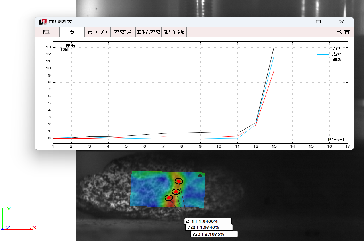
Pyrite drop hammer impact test
In fracture tests, DIC can provide displacement and strain field information at the crack tip, helping analyze the mechanism and path of crack propagation and further predict the fracture behavior of structures.
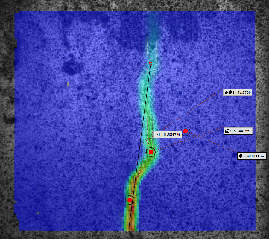
Three-point bending test of precast concrete beam opening
In multi-scale mechanical testing, DIC can cover scales from macro to micro by adjusting the optical system. For example, at the micro/nano scale, DIC can measure the deformation and strain of tiny structures such as thin films and microbeams.
In biomechanical testing,DIC technology can be used to measure the mechanical properties of biological tissues and implants, such as the strain distribution of bones and soft tissues, providing data support for biomechanical research.
In displacement and deformation measurement, DIC measures displacement and deformation by tracking changes in object surface images. It can measure the surface deformation of a material or structure at any moment after loading, providing accurate data for mechanical property analysis.
In finite element analysis, experimental data obtained by DIC can be used to validate finite element analysis (FEA) models, improving the accuracy and reliability of simulation results.





 Downloads

