Materials Mechanics
Monocular 3D Video Extensometer



Monocular 2D Optical Strain Measurement System
Monocular 3D Optical Strain Measurement System
High-Speed Monocular 3D Optical Strain Measurement System
Stereo 3D Optical Strain Measurement System
Optical Strain Measurement System – Educational Edition
2D Optical Microscopic Strain Measurement System


Strain Measurement of Parallel Lap Welds
Residual Deformation Measurement of Drilled Welded Plates
Full-Field Strain Measurement of Weldments in Compression
Tensile Deformation Measurement of 0.3mm Fiber Filament
Unmarked Compression Deformation Measurement of Composite Materials

Deformation Measurement of Artificial Cardiac Patch
Keycap Vibration Measurement: Quantifying Press and Rebound Dynamics
Headband Deformation Measurement: Analyzing Bending Position and Unloading Recovery
High-Temperature DIC Measurement of Wafer Thermal Warpage: Quantifying Warpage vs. Temperature
UAV Dynamic Tracking Measurement: Capturing Flight Trajectory and Attitude Changes

 0755-86347753

Published: 2024-11-21
A video extensometer is a non-contact strain measurement device based on digital image correlation (DIC) technology, used to measure the strain of materials during tensile testing. Compared with traditional mechanical extensometers,video extensometer has the following advantages in tensile testing of metal materials:
1. Non-contact measurement: the video extensometer computes strain by capturing the displacement of markers or patterns on the specimen surface with a camera, without physical contact. This avoids the local influence mechanical extensometers impose on the specimen during testing, with obvious advantages especially when testing thin-sheet materials, coated materials or other sensitive materials.
2. Adaptable to various specimen sizes: the video extensometer flexibly accommodates specimens of different sizes and shapes. For small or irregularly shaped specimens that conventional mechanical extensometers can hardly clamp or measure, the video extensometer can easily cover them by adjusting the camera field of view.
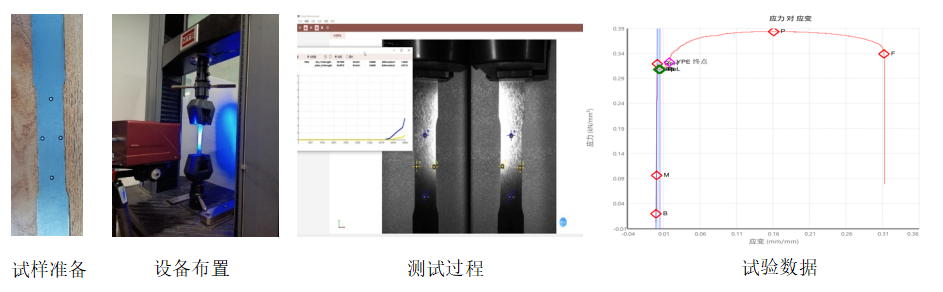
The above case is a tensile test conducted by Haytham Technology on a 0.17mm thick metal sheet according to GB/T 228.1-2010 Metallic Materials — Tensile Testing at Room Temperature, obtaining r-value/n-value, specified plastic extension strength (Rp0.2), elastic modulus, yield strength, fracture elongation and other data.
3. High-precision measurement: using a high-resolution camera, the video extensometer achieves micron-level displacement measurement accuracy, especially suitable for tensile testing of metal materials requiring high-precision strain measurement. This high precision helps accurately determine the yield point, elastic modulus and other mechanical properties of materials.
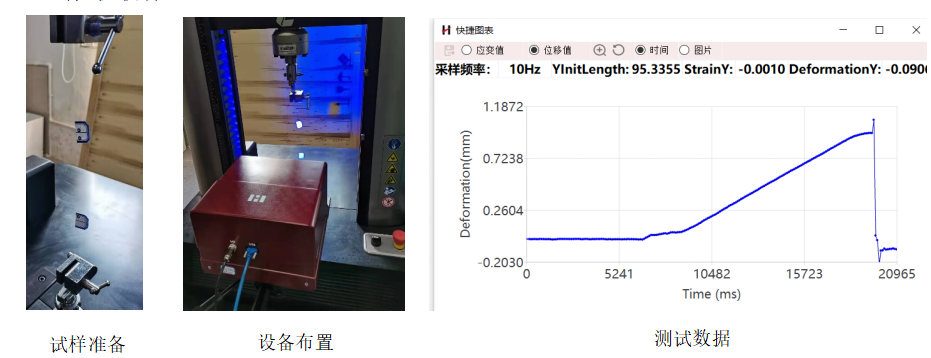
Metal wire tension
4. No specimen surface treatment needed: compared with mechanical extensometers requiring surface treatment or bonding, the video extensometer usually only needs simple marks on the specimen surface or natural surface features to measure, simplifying specimen preparation.
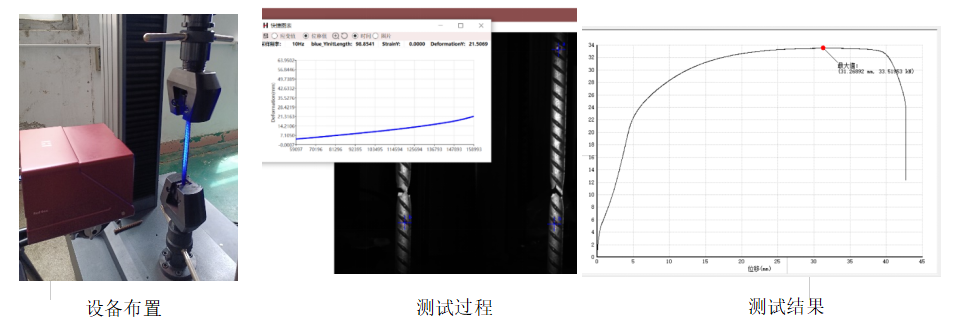
Featureless tensile test of rebar
5. Real-time dynamic measurement: the video extensometer monitors specimen displacement and strain changes in real time and analyzes them instantly through software. This makes it ideal for observing stress-strain curves, yield phenomena and fracture behavior of materials during tension.
6. Full-field strain measurement: althoughvideo extensometer is mainly used to measure the strain between two points, but it can also achieve local or full-field strain measurement by tracking multiple markers, which is very useful when studying the strain distribution across different regions of the specimen surface.
7. Reduced specimen damage: traditional mechanical extensometers may cause additional damage when the specimen fractures, even affecting results. The video extensometer, through non-contact measurement, completely avoids this, ensuring the purity and accuracy of testing.
8. Long measurement range: the video extensometer is not limited by the range of a conventional extensometer and can measure over a wide strain range (from tiny deformation to fracture), suitable for full-range mechanical property testing of different metal materials.
9. Data analysis and recording:video extensometerUsually equipped with powerful data analysis software, it records displacement and strain data synchronously and supports image replay and analysis, which is very helpful for post-test analysis and verification.





 Downloads

