Materials Mechanics
Monocular 3D Video Extensometer



Monocular 2D Optical Strain Measurement System
Monocular 3D Optical Strain Measurement System
High-Speed Monocular 3D Optical Strain Measurement System
Stereo 3D Optical Strain Measurement System
Optical Strain Measurement System – Educational Edition
2D Optical Microscopic Strain Measurement System


Strain Measurement of Parallel Lap Welds
Residual Deformation Measurement of Drilled Welded Plates
Full-Field Strain Measurement of Weldments in Compression
Tensile Deformation Measurement of 0.3mm Fiber Filament
Unmarked Compression Deformation Measurement of Composite Materials

Deformation Measurement of Artificial Cardiac Patch
Keycap Vibration Measurement: Quantifying Press and Rebound Dynamics
Headband Deformation Measurement: Analyzing Bending Position and Unloading Recovery
High-Temperature DIC Measurement of Wafer Thermal Warpage: Quantifying Warpage vs. Temperature
UAV Dynamic Tracking Measurement: Capturing Flight Trajectory and Attitude Changes

 0755-86347753

Published: 2025-06-13
Monitoring and evaluating cracks that develop in material structures during service is key to ensuring their safety and life. DIC provides full-field principal strain and displacement images during crack propagation, revealing the mechanical mechanisms of crack initiation, development, turning and instability through visualization.
InFoam aluminum three-point bending test, the DIC system records in real time the strain concentration and path evolution of the crack tip area, capturing the whole process of cracks initiating along micropore walls, propagating and finally fracturing, revealing typical failure modes such as local crushing and ligament fracture. Compared with traditional methods, DIC requires no sensor bonding or shutdown observation and can continuously capture images during loading, obtaining more complete and continuous crack behavior data — especially suitable for porous structures and non-uniform materials.
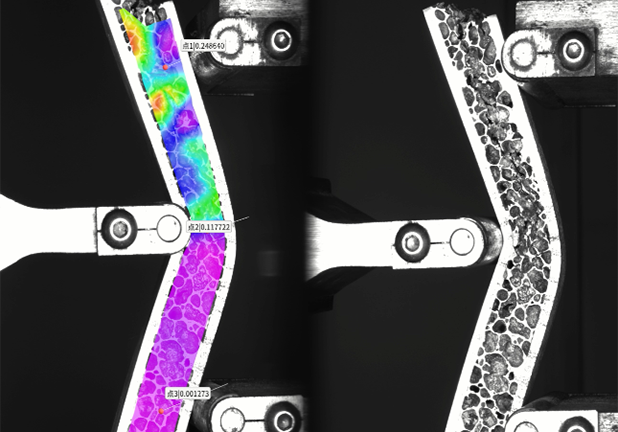
In complex components such as bionic structures or welded joints, DIC can also reveal the microscopic features of crack propagation along heterogeneous interfaces, supporting fatigue life prediction and fracture model optimization. The Haytham DIC system, with high resolution, high dynamic range and real-time computing capability, is competent for strain tracking and crack mechanism research during the fracture of materials such as aluminum foam — an important auxiliary tool for fracture mechanics and damage tolerance design.





 Downloads

