Materials Mechanics
Monocular 3D Video Extensometer



Monocular 2D Optical Strain Measurement System
Monocular 3D Optical Strain Measurement System
High-Speed Monocular 3D Optical Strain Measurement System
Stereo 3D Optical Strain Measurement System
Optical Strain Measurement System – Educational Edition
2D Optical Microscopic Strain Measurement System


Strain Measurement of Parallel Lap Welds
Residual Deformation Measurement of Drilled Welded Plates
Full-Field Strain Measurement of Weldments in Compression
Tensile Deformation Measurement of 0.3mm Fiber Filament
Unmarked Compression Deformation Measurement of Composite Materials

Deformation Measurement of Artificial Cardiac Patch
Keycap Vibration Measurement: Quantifying Press and Rebound Dynamics
Headband Deformation Measurement: Analyzing Bending Position and Unloading Recovery
High-Temperature DIC Measurement of Wafer Thermal Warpage: Quantifying Warpage vs. Temperature
UAV Dynamic Tracking Measurement: Capturing Flight Trajectory and Attitude Changes

 0755-86347753

Published: 2026-03-24
In bridge safety management, besides crack monitoring, displacement and deformation monitoring are also high-frequency needs. Especially when bridges serve for long periods with complex load changes and variable environmental conditions, bridge displacement, deflection and local deformation often directly reflect whether the structural state is stable.
In the early consultation stage, many projects pay attention to bridge displacement monitoring systems, bridge deformation monitoring solutions,online bridge deflection monitoringissues. Because for bridge management units, the most important thing is not to produce a single test result, but to find out whether abnormal changes have occurred during the long-term operation of the bridge.
Bridges are not static. Vehicle loads, temperature differences, bearing condition, foundation effects and material aging all make the structure show different degrees of displacement and deformation at different stages. Changes within a certain range may be normal responses, but if the change trend keeps expanding, or local responses clearly deviate from the normal state, attention is needed.
This is also why bridge displacement and deformation monitoring increasingly emphasize the word continuous.
A single test result only tells us the data at one moment, while continuous monitoring shows a process. For bridges, the process is often more valuable than single-point results, because what truly affects judgment is usually not the current displacement value, but whether it keeps increasing, whether the change is regular, and whether it correlates with environment, loads or other defect changes.
Haytham bridge safety monitoring system can provide monitoring solutions closer to engineering practice around bridge displacement, deformation and other scenarios. Through front-end monitoring devices and platform-based management, the system continuously records and remotely manages bridge structural changes, allowing managers to grasp the bridge's condition evolution more efficiently.
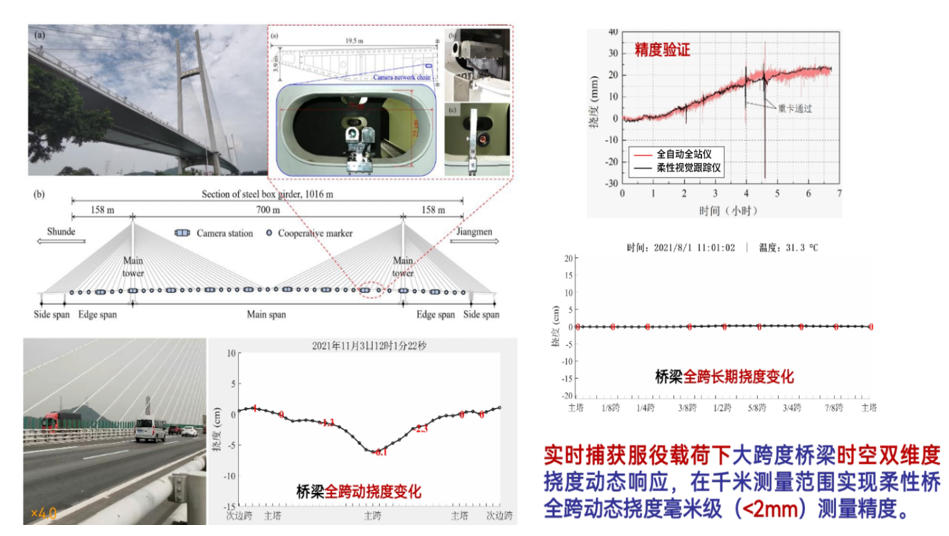
Compared with traditional single inspection, the advantages of continuous monitoring are mainly reflected in three aspects.
First, the change trend becomes clearer. Bridge structural problems often do not form instantly but emerge gradually during long-term operation. Only continuous data can help users judge whether a change is an occasional fluctuation or a long-term trend.
Second, anomaly identification is more timely. Many bridge problems are not obvious in their early stage, but with continuous records it is easier to spot signs from subtle changes. For safety management, the earlier the discovery, the larger the room for subsequent response.
Third, data management becomes more valuable. Displacement and deformation monitoring is not just for real-time viewing, but for long-term archiving and review. Through platform-based management, historical data, change curves and phased results can be uniformly saved, providing the basis for subsequent evaluation and decisions.
In practical application, the Haytham bridge safety monitoring system focuses more on turning monitoring results into real management value. That is, not just collecting data, but making data viewable, comparable, analyzable and traceable, so that bridge displacement and deformation monitoring truly serve daily maintenance and long-term O&M.
For bridge projects, the meaning of displacement and deformation monitoring is not just knowing how much the bridge has changed, but knowing why it changed this way, whether the change is normal, and whether it deserves key attention next. The answers to these questions are usually built on long-term, continuous and credible data.
Therefore,bridge displacement monitoring and deformation monitoring is not the monitoring itself, but using continuous observation to make the bridge condition clearer and management decisions better founded. This is the value of Haytham's continued focus on bridge safety monitoring systems.





 Downloads

