Materials Mechanics
Monocular 3D Video Extensometer



Monocular 2D Optical Strain Measurement System
Monocular 3D Optical Strain Measurement System
High-Speed Monocular 3D Optical Strain Measurement System
Stereo 3D Optical Strain Measurement System
Optical Strain Measurement System – Educational Edition
2D Optical Microscopic Strain Measurement System


Strain Measurement of Parallel Lap Welds
Residual Deformation Measurement of Drilled Welded Plates
Full-Field Strain Measurement of Weldments in Compression
Tensile Deformation Measurement of 0.3mm Fiber Filament
Unmarked Compression Deformation Measurement of Composite Materials

Deformation Measurement of Artificial Cardiac Patch
Keycap Vibration Measurement: Quantifying Press and Rebound Dynamics
Headband Deformation Measurement: Analyzing Bending Position and Unloading Recovery
High-Temperature DIC Measurement of Wafer Thermal Warpage: Quantifying Warpage vs. Temperature
UAV Dynamic Tracking Measurement: Capturing Flight Trajectory and Attitude Changes

 0755-86347753

Published: 2026-06-29
extensometers, the Haytham video extensometer adopts single-camera DIC digital image correlation technology: it captures specimen surface images with a camera, identifies the displacement changes of the gauge area through algorithms, and calculates axial strain, transverse strain, displacement and deformation data.
The core advantage of single-camera DIC is non-contact measurement. During testing, the device needs no specimen clamping and adds no extra mass or stiffness to the specimen — especially suitable for thin sheets, rubber, plastics, composites, metal specimens and large-deformation materials. For specimens that slip easily, fracture easily or are unsuitable for clamping, the video extensometer effectively reduces human interference, keeping test results closer to the material's true deformation state.
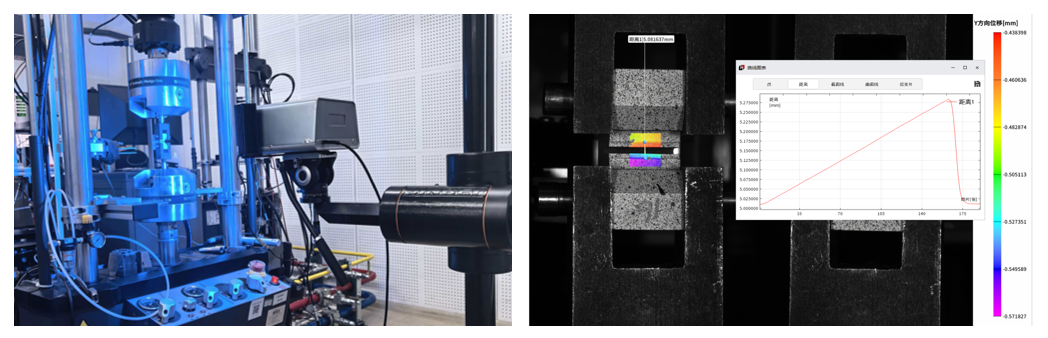
CT specimen point-spacing deformation measurement
Haytham video extensometer supports automatic recognition of markers such as dots, horizontal lines, crosses and QR codes; gauge lengths can be set according to test needs, stress-strain curves are output in real time, and data can be synchronized with testing machine force. The device is calibrated before leaving the factory, so users can start testing right after installation, reducing complex commissioning.
In high- and low-temperature environments, conventional contact extensometers are often limited by fixtures, temperature compensation and installation space, while the Haytham video extensometer can be used in complex scenarios such as high-temperature furnaces and low-temperature chambers, achieving long-distance, non-contact, high-precision strain measurement.
For laboratories that need to improve testing efficiency, reduce specimen interference and expand measurement scenarios, single-camera DICvideo extensometer is a more flexible and intuitive strain measurement solution.





 Downloads

