Materials Mechanics
Monocular 3D Video Extensometer



Monocular 2D Optical Strain Measurement System
Monocular 3D Optical Strain Measurement System
High-Speed Monocular 3D Optical Strain Measurement System
Stereo 3D Optical Strain Measurement System
Optical Strain Measurement System – Educational Edition
2D Optical Microscopic Strain Measurement System


Strain Measurement of Parallel Lap Welds
Residual Deformation Measurement of Drilled Welded Plates
Full-Field Strain Measurement of Weldments in Compression
Tensile Deformation Measurement of 0.3mm Fiber Filament
Unmarked Compression Deformation Measurement of Composite Materials

Deformation Measurement of Artificial Cardiac Patch
Keycap Vibration Measurement: Quantifying Press and Rebound Dynamics
Headband Deformation Measurement: Analyzing Bending Position and Unloading Recovery
High-Temperature DIC Measurement of Wafer Thermal Warpage: Quantifying Warpage vs. Temperature
UAV Dynamic Tracking Measurement: Capturing Flight Trajectory and Attitude Changes

 0755-86347753

Published: 2026-06-29
When choosing a video extensometer, do not look only at the equipment appearance or a single accuracy indicator; judge comprehensively by specimen type, test environment, deformation range and data output needs. For material laboratories, a suitable video extensometer should simultaneously satisfy accuracy, stability, usability and scenario adaptability.
First, focus on the measurement method. The Haytham video extensometer uses single-camera DIC digital image correlation technology to achieve non-contact strain measurement. Compared with contact extensometers, it does not clamp the specimen and is more suitable for thin sheets, soft materials, composites, rubber, plastics and large-deformation material testing.
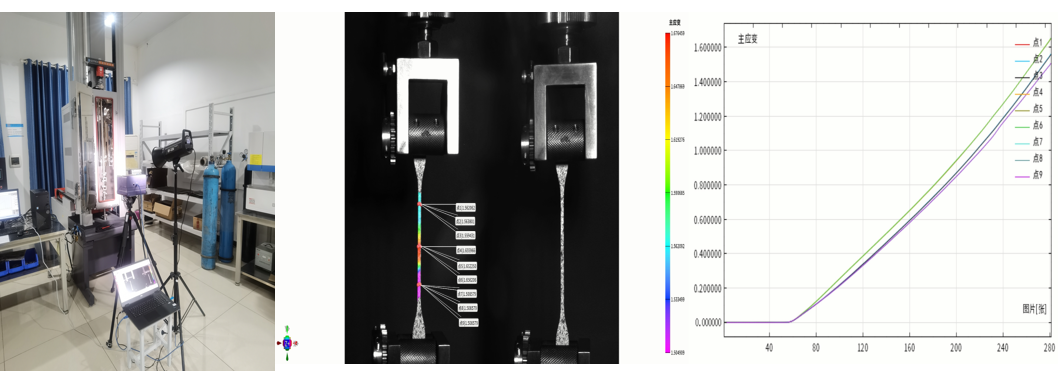
Full-field strain measurement of rubber in tension
Second, pay attention to the accuracy class. Strain measurement equipment must meet experimental standard requirements — especially in metal tension, quality inspection and research testing, accuracy directly affects the credibility of results. The Haytham video extensometer supports high-precision strain measurement, usable in conventional tension, compression, bending and complex material testing scenarios.
Third, pay attention to gauge length setting capability. Different specimen sizes and test standards have different gauge length requirements. A video extensometer should support flexible gauge length settings and enable axial, transverse or multi-gauge measurement. The Haytham video extensometer supports manual gauge length input and automatic recognition of various markers, improving testing efficiency.
Fourth, pay attention to environmental adaptability. If the experiment involves high-temperature furnaces, low-temperature chambers or large-deformation materials, it is critical whether the device supports long-distance observation, stable acquisition and continuous tracking. The single-camera DIC video extensometer has obvious advantages in these scenarios.
Finally, pay attention to data linkage capability. An excellent video extensometer should not only measure strain, but also synchronize with the force data of the testing machine and generate stress-strain curves in real time, facilitating experimental analysis, report output and data traceability.
Overall, the Haytham video extensometer suits users who want to improve testing efficiency, reduce contact interference and expand into complex testing scenarios; it is a non-contact strain measurement solution worth considering in mechanical testing of materials.





 Downloads

