Materials Mechanics
Monocular 3D Video Extensometer



Monocular 2D Optical Strain Measurement System
Monocular 3D Optical Strain Measurement System
High-Speed Monocular 3D Optical Strain Measurement System
Stereo 3D Optical Strain Measurement System
Optical Strain Measurement System – Educational Edition
2D Optical Microscopic Strain Measurement System


Strain Measurement of Parallel Lap Welds
Residual Deformation Measurement of Drilled Welded Plates
Full-Field Strain Measurement of Weldments in Compression
Tensile Deformation Measurement of 0.3mm Fiber Filament
Unmarked Compression Deformation Measurement of Composite Materials

Deformation Measurement of Artificial Cardiac Patch
Keycap Vibration Measurement: Quantifying Press and Rebound Dynamics
Headband Deformation Measurement: Analyzing Bending Position and Unloading Recovery
High-Temperature DIC Measurement of Wafer Thermal Warpage: Quantifying Warpage vs. Temperature
UAV Dynamic Tracking Measurement: Capturing Flight Trajectory and Attitude Changes

 0755-86347753

Published: 2026-03-24
During long-term operation, bridges are continuously affected by vehicle loads, ambient temperature, wind loads, material aging and other factors. For management units, the difficulty of bridge safety management has never been just finding problems, but finding them as early as possible and continuously grasping structural condition changes.
This is also why bridge safety monitoring systems are attracting more and more attention.
Traditional bridge inspection mainly relies on manual periodic checks. This approach remains important in daily maintenance, but for long-term change problems such as cracks, displacement, deflection and vibration, manual inspection alone often has limitations: long cycles, insufficient continuity and incomplete data retention. Especially as bridges keep expanding in scale and management requirements keep rising, relying solely on manual methods can hardly meet more refined safety management needs.
bridge safety monitoring system, in essence, is a technology system that continuously senses, automatically acquires, remotely transmits, displays on a platform and analyzes trends for key bridge parts, key parameters and key change processes. It does not simply add a few monitoring points, but helps users build long-term understanding of the bridge's operating state.
For bridge projects, truly valuable monitoring is not just obtaining one test result, but continuously recording the change trajectory of the bridge during operation. For example, whether cracks have propagated, whether structural displacement is abnormal, and whether local deformation is growing — these all rely more on continuous data than on isolated conclusions at a single time point.
Haytham bridge safety monitoring system, focusing on the key monitoring needs of long-term bridge operation, provides monitoring solutions closer to engineering practice around cracks, displacement, deformation and other issues. The system runs through the coordination of front-end sensing devices, data acquisition and transmission units, and the monitoring cloud platform, so that field monitoring data can be acquired in time, managed centrally and analyzed continuously.
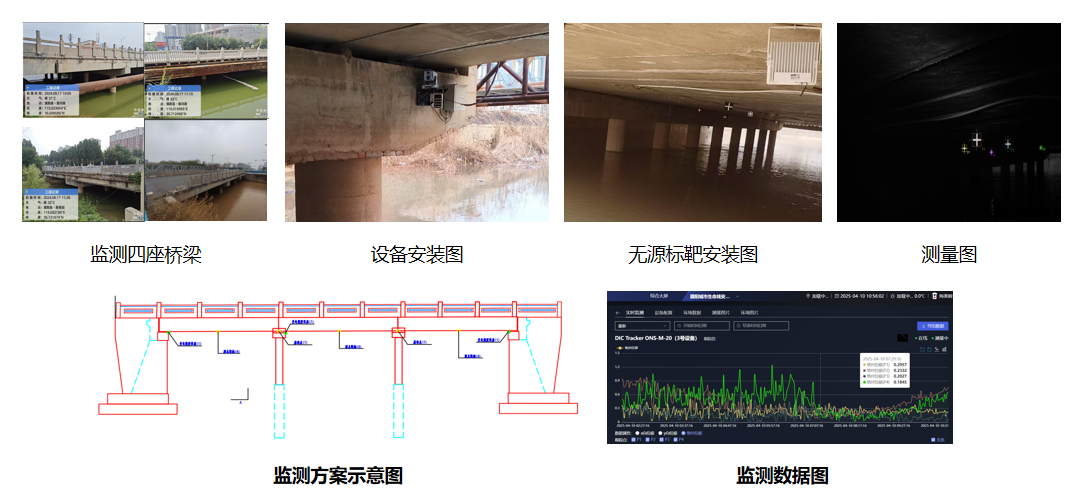
Compared with the traditional approach of relying on frequent manual site visits, the value of bridge safety monitoring systems is mainly reflected in three aspects.
First, it makes bridge condition changes continuously visible. Many structural problems do not appear suddenly but develop gradually under long-term action. Without continuous records, it is hard to accurately judge when a problem appeared, how fast it changed and its scope of influence. Continuous monitoring turns previously scattered inspection results into a comparable and traceable change process.
Second, it makes management more efficient. Bridge projects often have scattered points, long cycles and complex management chains. Through online monitoring and remote platforms, managers need not frequently travel to the site to view data and change trends in time, improving daily management efficiency.
Third, make the basis for judgment more complete. A monitoring system that truly serves bridge safety management does not merely collect data; it makes the data understandable, verifiable and usable for subsequent decisions. In its scheme design, the Haytham system emphasizes result visualization, data retention and change tracking, moving monitoring from data collection toward assisted judgment.
As bridge O&M gradually enters a stage focusing more on long-term condition management and digital management, bridge safety monitoring systems are no longer just a configuration for key projects, but a direction watched by more and more bridge management units.
For users, choosingbridge safety monitoring system, the key is not just what the equipment can measure, but whether the system can adapt to the bridge scenario, explain structural changes clearly, and be truly usable in actual management. What Haytham does is focus on exactly this, making bridge safety monitoring closer to the field and closer to management needs.





 Downloads

