Materials Mechanics
Monocular 3D Video Extensometer



Monocular 2D Optical Strain Measurement System
Monocular 3D Optical Strain Measurement System
High-Speed Monocular 3D Optical Strain Measurement System
Stereo 3D Optical Strain Measurement System
Optical Strain Measurement System – Educational Edition
2D Optical Microscopic Strain Measurement System


Strain Measurement of Parallel Lap Welds
Residual Deformation Measurement of Drilled Welded Plates
Full-Field Strain Measurement of Weldments in Compression
Tensile Deformation Measurement of 0.3mm Fiber Filament
Unmarked Compression Deformation Measurement of Composite Materials

Deformation Measurement of Artificial Cardiac Patch
Keycap Vibration Measurement: Quantifying Press and Rebound Dynamics
Headband Deformation Measurement: Analyzing Bending Position and Unloading Recovery
High-Temperature DIC Measurement of Wafer Thermal Warpage: Quantifying Warpage vs. Temperature
UAV Dynamic Tracking Measurement: Capturing Flight Trajectory and Attitude Changes

 0755-86347753

Published: 2026-03-24
When looking for a bridge safety monitoring solution, many users initially focus on equipment parameters such as measurement range, accuracy, installation method and transmission method. These are certainly important, but at the implementation stage, people find that whether a bridge safety monitoring system works well is determined not only by the equipment itself.
Because bridge monitoring has never been a single equipment purchase issue, but a complete application issue.
one set of bridge safety monitoring systemWhether it suits the project depends first on whether it matches the bridge's real needs. Different bridges care about different problems: some focus on cracks, some on displacement, some on overall deformation, and others on condition trends during long-term operation. If the scheme only emphasizes equipment capability without matching the bridge's actual scenario, the system's value can hardly be realized.
Second, check whether the system can adapt to site conditions.
Bridge projects are often characterized by wide distribution, complex environments, limited installation conditions and long operation periods. Therefore, a monitoring system must go beyond lab-level measurement capability and work at the engineering site level: easy to install, able to transmit, view and use over the long term. Convenient installation, flexible front-end deployment, easy maintenance and stable data transmission all directly affect the project experience.
Third, check whether the monitoring results are truly easy to manage.
Many systems can output data, but if the data is scattered, hard to view and historical records are difficult to retrieve, the practical value is greatly reduced for management units.bridge safety monitoring ultimately serves bridge maintenance and safety management, so whether the platform display is intuitive, results are easy to review, trends are clear and records are traceable is often more important than a few parameters alone.
The Haytham bridge safety monitoring system targets the actual needs of long-term bridge operation, providing solutions closer to engineering practice around key issues such as cracks, displacement and deformation. The system cares not only about front-end sensing capability but also about the overall coordination of data transmission, platform management and long-term O&M, so that monitoring results do not stay at the acquisition end but truly enter the management process.
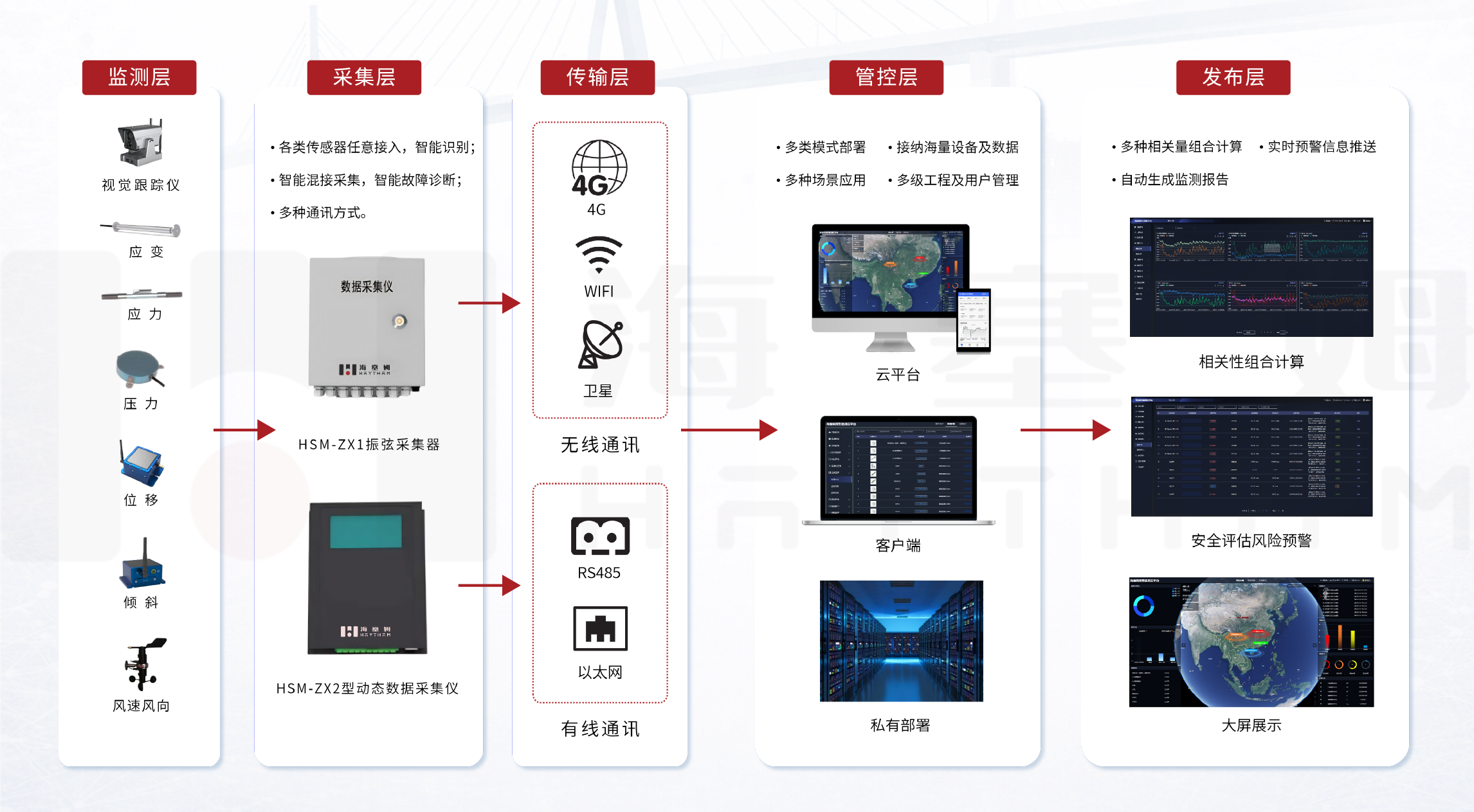
From a user's perspective, when choosing a bridge safety monitoring system, several questions deserve key attention.
First, whether the system is designed around the bridge scenario, rather than simply moving general-purpose equipment onto the bridge.
Second, whether the system can explain the monitoring results clearly — not just give data, but help users understand the change process.
Third, whether the system is convenient for long-term use, including installation, viewing, maintenance, archiving and review.
Fourth, whether the supplier understands bridge monitoring needs rather than just providing single-point devices.
Haytham inbridge safety monitoring system, more emphasis is placed on the match between the scheme and the scenario. Because for bridge projects, what is truly valuable is not buying a system, but whether the system can serve bridge management stably over the long term. The ultimate goal of bridge monitoring is not to add technical configurations, but to make the bridge condition clearer, management more proactive, and maintenance and decisions better founded.
Therefore, choosing a bridge safety monitoring system cannot rely only on equipment parameters; what matters more is whether it can enter the real workflow of bridge projects. Only a system that truly helps users see changes clearly, reduce repetitive work and improve management efficiency suits long-term bridge safety management.





 Downloads

