Materials Mechanics
Monocular 3D Video Extensometer



Monocular 2D Optical Strain Measurement System
Monocular 3D Optical Strain Measurement System
High-Speed Monocular 3D Optical Strain Measurement System
Stereo 3D Optical Strain Measurement System
Optical Strain Measurement System – Educational Edition
2D Optical Microscopic Strain Measurement System


Strain Measurement of Parallel Lap Welds
Residual Deformation Measurement of Drilled Welded Plates
Full-Field Strain Measurement of Weldments in Compression
Tensile Deformation Measurement of 0.3mm Fiber Filament
Unmarked Compression Deformation Measurement of Composite Materials

Deformation Measurement of Artificial Cardiac Patch
Keycap Vibration Measurement: Quantifying Press and Rebound Dynamics
Headband Deformation Measurement: Analyzing Bending Position and Unloading Recovery
High-Temperature DIC Measurement of Wafer Thermal Warpage: Quantifying Warpage vs. Temperature
UAV Dynamic Tracking Measurement: Capturing Flight Trajectory and Attitude Changes

 0755-86347753

Published: 2026-06-29
In mechanical testing of materials, traditional measurement usually relies on strain gauges, extensometers or displacement sensors. These methods obtain local data, but when the specimen shows non-uniform deformation, local strain concentration, crack propagation or complex failure, single-point measurement often fails to fully reflect the true state of the material.
Haytham DICsystems acquires full-field displacement and full-field strain data of the specimen surface through non-contact image measurement. Users can see not only the deformation value of a single point but also the deformation distribution across the entire area, and thus judge the weak positions and failure trends of the material during loading.
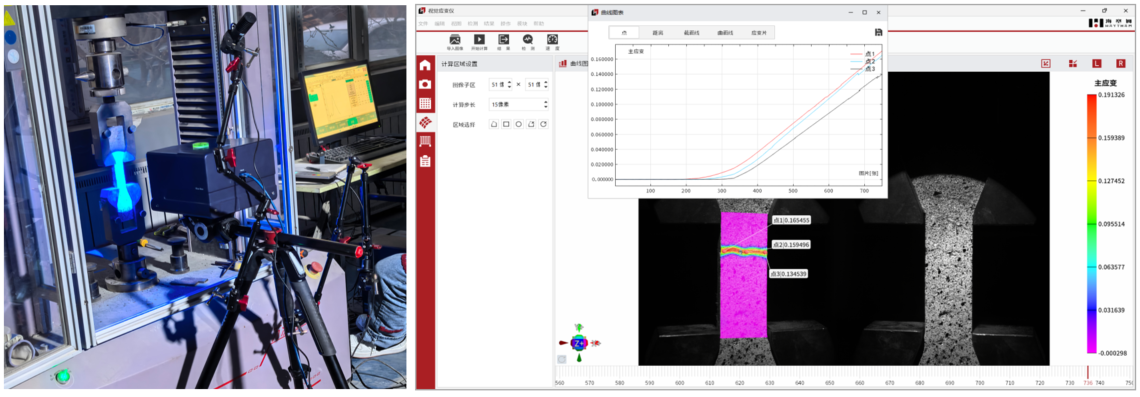
Full-field strain measurement of concrete in tension
For example, in composite tensile testing, the DIC system can identify local strain concentration in the layup structure; in welded structure testing, it can analyze deformation differences near the weld seam and heat-affected zone; in rubber, film and elastomer testing, it can continuously track large-deformation processes; in metal material testing, it can observe strain evolution in the necking area.
The Haytham DIC system is suitable for tension, compression, bending, shear, fatigue, impact, high temperature, low temperature and many other experimental scenarios. Compared with contact measurement, it requires no strain gauge bonding and no specimen clamping, reducing interference with the test object and improving the authenticity and completeness of data.
In addition, HaythamDICsystems supports synchronized analysis of images, curves, contour maps and data results, making it easy for users to prepare test reports, study failure mechanisms and compare with simulation results. The system is calibrated before leaving the factory, reducing on-site commissioning time and making the experimental workflow more efficient.
For users who need to analyze the overall deformation behavior of materials, the DIC system is not just a measuring tool but a visualized analysis means for understanding mechanical properties.





 Downloads

