Materials Mechanics
Monocular 3D Video Extensometer



Monocular 2D Optical Strain Measurement System
Monocular 3D Optical Strain Measurement System
High-Speed Monocular 3D Optical Strain Measurement System
Stereo 3D Optical Strain Measurement System
Optical Strain Measurement System – Educational Edition
2D Optical Microscopic Strain Measurement System


Strain Measurement of Parallel Lap Welds
Residual Deformation Measurement of Drilled Welded Plates
Full-Field Strain Measurement of Weldments in Compression
Tensile Deformation Measurement of 0.3mm Fiber Filament
Unmarked Compression Deformation Measurement of Composite Materials

Deformation Measurement of Artificial Cardiac Patch
Keycap Vibration Measurement: Quantifying Press and Rebound Dynamics
Headband Deformation Measurement: Analyzing Bending Position and Unloading Recovery
High-Temperature DIC Measurement of Wafer Thermal Warpage: Quantifying Warpage vs. Temperature
UAV Dynamic Tracking Measurement: Capturing Flight Trajectory and Attitude Changes

 0755-86347753

Published: 2026-06-30
Strain gauges are common measurement tools in material testing, suitable for obtaining strain data at local positions. However, for complex structures, non-uniform materials, large-deformation specimens and multi-area deformation analysis, strain gauges provide only limited measuring points and can hardly reflect the overall deformation state of the specimen.
Haytham DICsystems uses digital image correlation technology: a camera captures specimen surface images, and algorithms compute full-field displacement and strain. Compared with strain gauges, the biggest difference of a DIC system is that it measures not a point but an area.
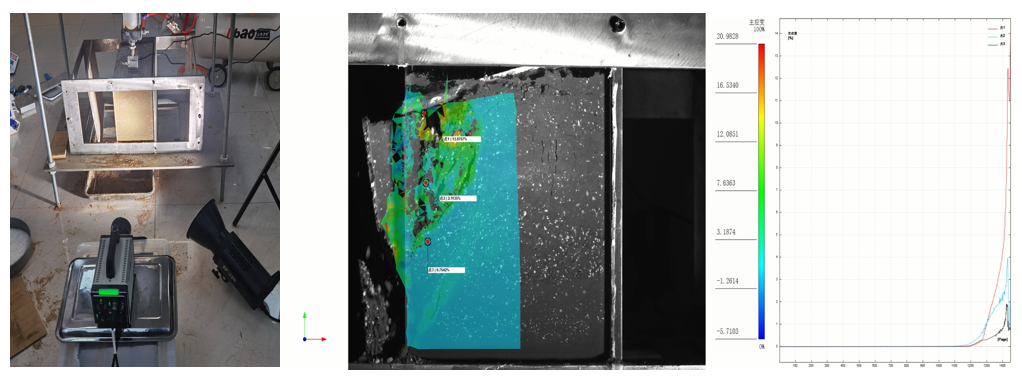
Soil compression collapse test
In actual testing, the DIC system can generate strain contour maps, intuitively showing the deformation degree at different positions of the specimen. Users can clearly see strain concentration areas, crack initiation positions, necking development and structural weak areas. This is very important for material research, failure analysis and structural optimization.
Strain gauges need to be bonded to the specimen surface; the operation requires certain personnel experience and can be affected by the adhesive layer, temperature, wiring and installation position. The DIC system uses non-contact measurement and requires no sensors on the specimen, especially suitable for films, rubber, composites, tiny structures and high/low-temperature testing.
Haytham DICsystems not only outputs numerical results such as displacement and strain, but also displays images, curves and contour maps synchronously, making the test process more visualized. For users who need to understand the overall deformation behavior of materials, the DIC system provides richer data dimensions than single-point measurement.
In terms of system usage, the Haytham DIC system has a friendly operation process; key calibration is completed before leaving the factory, reducing on-site preparation time and improving experimental efficiency.





 Downloads

