Materials Mechanics
Monocular 3D Video Extensometer



Monocular 2D Optical Strain Measurement System
Monocular 3D Optical Strain Measurement System
High-Speed Monocular 3D Optical Strain Measurement System
Stereo 3D Optical Strain Measurement System
Optical Strain Measurement System – Educational Edition
2D Optical Microscopic Strain Measurement System


Strain Measurement of Parallel Lap Welds
Residual Deformation Measurement of Drilled Welded Plates
Full-Field Strain Measurement of Weldments in Compression
Tensile Deformation Measurement of 0.3mm Fiber Filament
Unmarked Compression Deformation Measurement of Composite Materials

Deformation Measurement of Artificial Cardiac Patch
Keycap Vibration Measurement: Quantifying Press and Rebound Dynamics
Headband Deformation Measurement: Analyzing Bending Position and Unloading Recovery
High-Temperature DIC Measurement of Wafer Thermal Warpage: Quantifying Warpage vs. Temperature
UAV Dynamic Tracking Measurement: Capturing Flight Trajectory and Attitude Changes

 0755-86347753

Published: 2026-06-30
choosing users should not look at a single parameter only, but judge comprehensively by test object, field of view, deformation magnitude, temperature environment, sampling needs and data analysis methods. Different test scenarios have different requirements for DIC systems.
First, look at the measurement object. If it is a standard metal specimen, a conventional DIC system meets basic deformation measurement needs; if it is rubber, plastics, films, composites or other large-deformation or non-uniform materials, the system needs good feature tracking and large-deformation analysis capability.
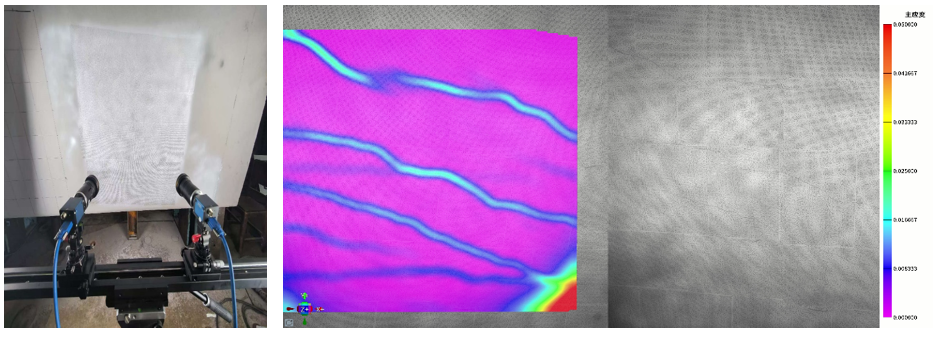
Four-point bending measurement of box girder
Next, look at the measurement dimensions. For planar deformation tests, 2D DIC can be chosen; for 3D topography, out-of-plane displacement and complex curved surfaces, a 3D DIC system is more suitable. Haytham DIC systems cover single-camera 3D, single-camera high-speed 3D, stereo 3D and other solutions, which can be flexibly selected according to test needs.
Third, look at the application environment. If the experiment involves high-temperature furnaces, low-temperature chambers, fatigue testing machines, high-speed impact or dynamic loading, attention must be paid to the system's environmental adaptability, sampling frequency, lighting configuration and data stability. The Haytham DIC system adapts to a variety of complex working conditions, meeting material research and structural testing needs.
Fourth, look at data analysis capability. The value of a DIC system lies not only in capturing images but in outputting usable data. Full-field displacement, full-field strain, contour map analysis, curve output, simulation comparison and report preparation are all functions to watch when selecting.
Finally, look at usage efficiency. For enterprise laboratories, university research platforms and testing institutions, whether the system is easy to deploy, operate and maintain is very important. The Haytham DIC system completes key calibration before leaving the factory, reducing on-site commissioning pressure and making the testing process smoother.
Overall, the Haytham DIC system suits material mechanical testing, structural deformation analysis, complex-condition experiments and R&D verification — a vision measurement solution oriented to non-contact full-field measurement needs.





 Downloads

