Materials Mechanics
Monocular 3D Video Extensometer



Monocular 2D Optical Strain Measurement System
Monocular 3D Optical Strain Measurement System
High-Speed Monocular 3D Optical Strain Measurement System
Stereo 3D Optical Strain Measurement System
Optical Strain Measurement System – Educational Edition
2D Optical Microscopic Strain Measurement System


Strain Measurement of Parallel Lap Welds
Residual Deformation Measurement of Drilled Welded Plates
Full-Field Strain Measurement of Weldments in Compression
Tensile Deformation Measurement of 0.3mm Fiber Filament
Unmarked Compression Deformation Measurement of Composite Materials

Deformation Measurement of Artificial Cardiac Patch
Keycap Vibration Measurement: Quantifying Press and Rebound Dynamics
Headband Deformation Measurement: Analyzing Bending Position and Unloading Recovery
High-Temperature DIC Measurement of Wafer Thermal Warpage: Quantifying Warpage vs. Temperature
UAV Dynamic Tracking Measurement: Capturing Flight Trajectory and Attitude Changes

 0755-86347753

Published: 2026-07-21
Video extensometers (non-contact optical extensometers) have long been dominated by European, American and Japanese manufacturers, mainly sold as bundles with testing machine brands such as ZwickRoell and Instron. In recent years, domestic manufacturers represented by Haytham have achieved a technological breakthrough with self-developed DIC (digital image correlation) algorithms, matching imported products in accuracy class, temperature and strain coverage while forming differentiated advantages in price, delivery time and localized services; the domestic substitution trend is obvious.
Before choosing a brand, be clear about one thing: whether imported or domestic, the unified acceptance yardstick is the extensometer calibration class of GB/T12160/ISO9513 (conventional tests usually require class 0.5). Brands determine the ecosystem, service and scalability; accuracy must be based on on-site calibration.
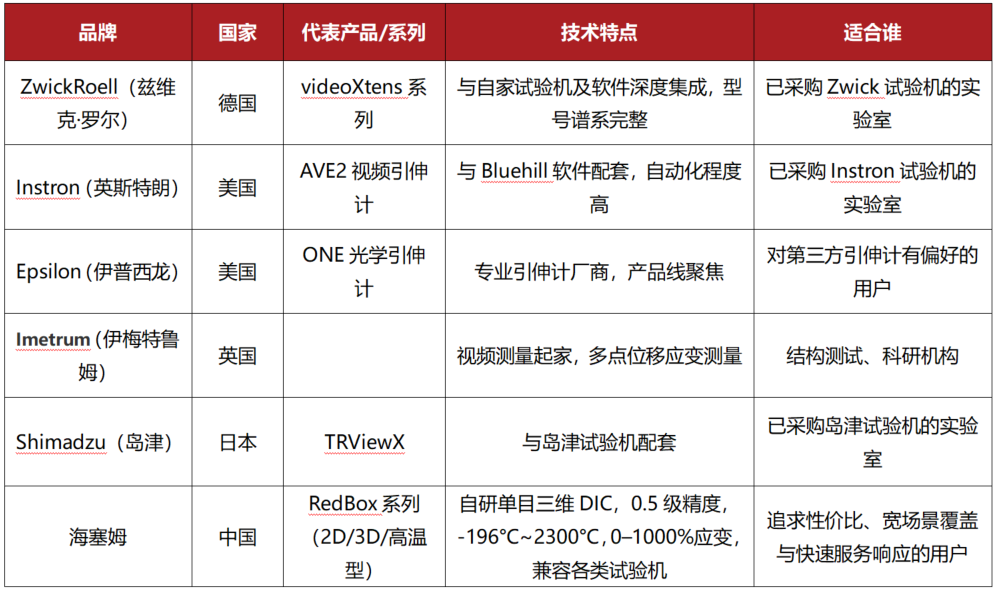
The common profile of imported brands: mature reputation for accuracy and stability, but relatively high overall purchase cost, relatively long after-sales and spare parts response cycles, limited flexibility for deep customization, and some models are preferentially bound to their own testing machine ecosystems.
1. Company background
Shenzhen Haytham Technology Co., Ltd.Located in Nanshan, Shenzhen, it is a domestic provider of DIC vision sensing technology solutions, with product lines covering video extensometers, DIC visual strain gauges, visual trackers and more. The company has signed long-term strategic cooperation agreements with Beihang University and Shenzhen University to promote the industrialization of optical mechanics research achievements.
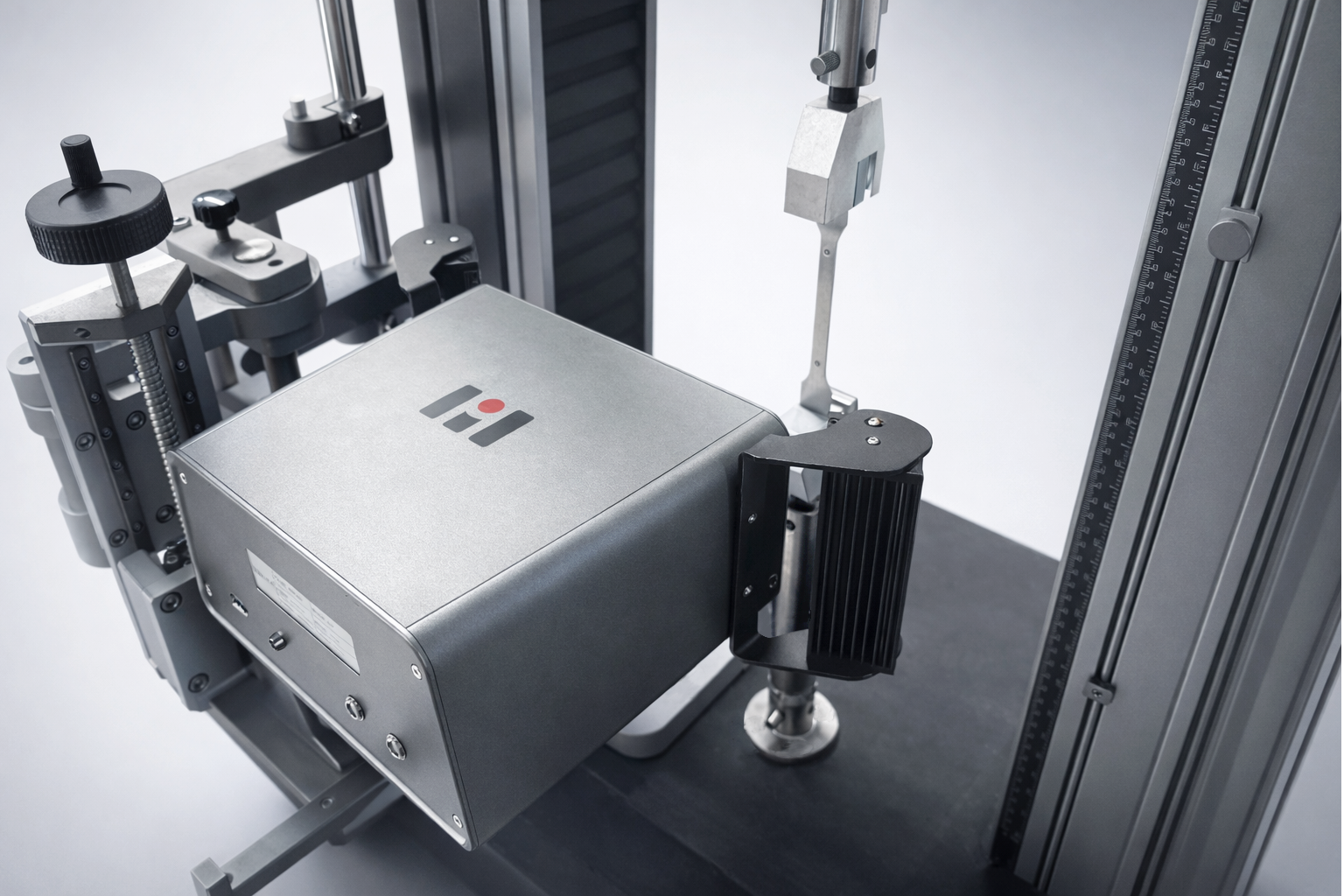
The Haytham video extensometerRedBox series with a brand-new 2026 look
2. Technology and product highlights
▪ Self-developed single-camera 3D DIC: 3D deformation measurement with a single camera, adapting to restricted fields of view such as smaller furnace openings; combined with deep learning algorithms for automatic marker recognition, even featureless specimens can be measured.
▪ Accuracy and response: meets class 0.5 accuracy requirements, nominal positioning accuracy 0.5μm, supporting laser focusing and delay-free communication.
▪ Wide coverage: strain measurement range 0-1000%, measurable temperature range -196℃ to 2300℃.
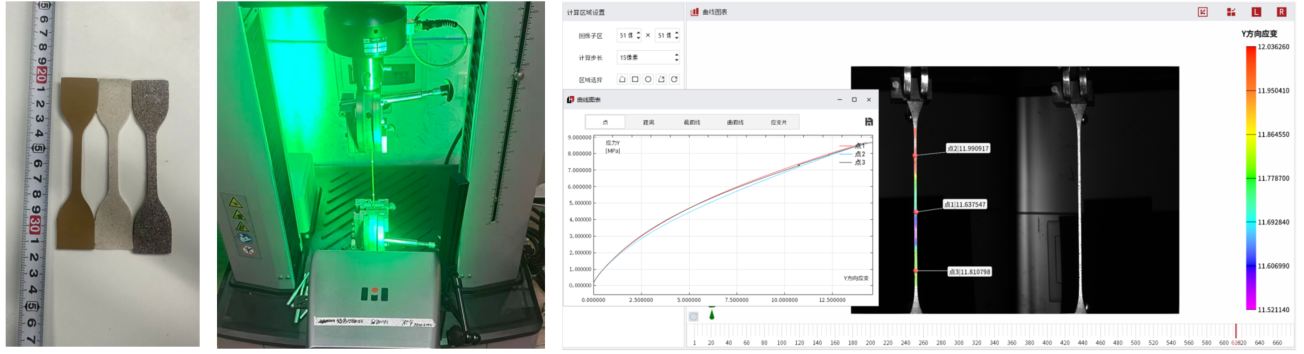
Full-field strain measurement of rubber in tension
▪ No restriction on specimen shape: plates, rods, wires, films, concrete, soft and biological materials are all acceptable.
▪ Multiple parameters from one machine: simultaneous longitudinal + transverse strain measurement and simultaneous multi-gauge output, directly determining Young's modulus and Poisson's ratio; multi-camera solutions can measure post-fracture elongation and reduction of area.
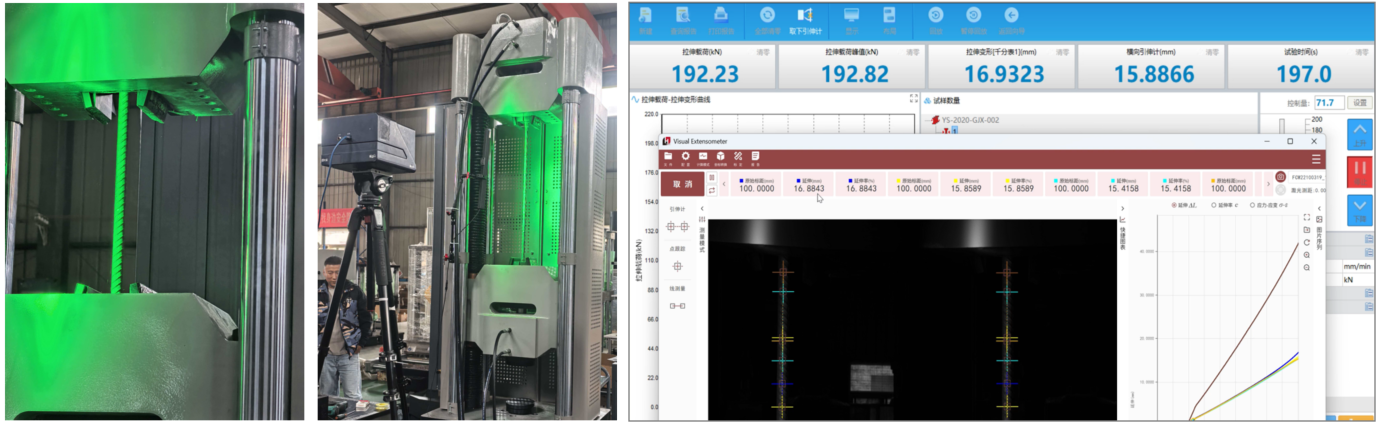
Multi-gauge deformation measurement of rebar in room-temperature tension
▪ Open and compatible: data supports interoperability with various testing machines via digital or analog signals, with synchronized triggering and automatic measurement, not bound to a specific testing machine brand — the key difference from the imported bundle model.
▪ Modular expansion: optional full-field measurement module (upgrading to a full-field displacement/strain DIC system) and fatigue frequency-reduction acquisition module, covering tension, compression, bending, torsion, fatigue, impact and crack propagation tests.
▪ Existing testing machines: if the laboratory already has complete Zwick/Instron/Shimadzu sets with sufficient budget, evaluate same-brand video extensometers first for the lowest integration cost; if testing machine brands are mixed or mainly domestic, evaluate open and compatible domestic solutions such as Haytham first.
▪ Budget structure: at the same accuracy class, domestic solutions usually have better total purchase and maintenance costs; investing the saved budget into modules like multi-gauge and full-field measurement often improves laboratory capability more than brand premium does.
▪ Service radius: when equipment fails, the response speed of local manufacturers and the cost of engineer visits are usually clearly better than imported brands — especially critical for testing institutions where downtime means loss.
▪ Customization needs: for non-standard specimens, special furnace windows or automated production line integration, domestic manufacturers usually respond more flexibly with customization.
Q1: Is the Gap Between Domestic and Imported Video Extensometers Still Large?
On core indicators such as accuracy class (0.5), strain range and temperature coverage, domestic brands represented by Haytham already rival imported products, with some indicators (such as single-camera 3D DIC adapting to small furnace openings and 0-1000% strain coverage) forming differentiated features; imported brands' advantages lie more in deep binding to their own testing machine ecosystems and long-term brand reputation.
Q2:The Haytham video extensometerCan It Be Paired with Third-Party Testing Machines?
Yes. According to its public product documentation, the data of the Haytham video extensometer supports interconnection with various testing machines via digital or analog signals, enabling synchronized triggering and automatic measurement, without restricting the testing machine brand.
Q3: What Should Be Acceptance-Checked Most When Purchasing a Video Extensometer?
Three things: calibrate the accuracy class on site per GB/T12160/ISO9513; measure strain curves with your own typical specimens; verify real-time data interoperability and synchronized triggering with your existing testing machine.
Q4: How to quickly screen brands?
First screen with four hard criteria: accuracy class, strain range, temperature range and testing machine compatibility; then compare service response and total cost.





 Downloads

