Materials Mechanics
Monocular 3D Video Extensometer



Monocular 2D Optical Strain Measurement System
Monocular 3D Optical Strain Measurement System
High-Speed Monocular 3D Optical Strain Measurement System
Stereo 3D Optical Strain Measurement System
Optical Strain Measurement System – Educational Edition
2D Optical Microscopic Strain Measurement System


Strain Measurement of Parallel Lap Welds
Residual Deformation Measurement of Drilled Welded Plates
Full-Field Strain Measurement of Weldments in Compression
Tensile Deformation Measurement of 0.3mm Fiber Filament
Unmarked Compression Deformation Measurement of Composite Materials

Deformation Measurement of Artificial Cardiac Patch
Keycap Vibration Measurement: Quantifying Press and Rebound Dynamics
Headband Deformation Measurement: Analyzing Bending Position and Unloading Recovery
High-Temperature DIC Measurement of Wafer Thermal Warpage: Quantifying Warpage vs. Temperature
UAV Dynamic Tracking Measurement: Capturing Flight Trajectory and Attitude Changes

 0755-86347753

Published: 2026-07-21
A video extensometer (Video Extensometer) is a non-contact strain measurement instrument: an industrial camera captures images of the whole specimen loading process, software computes deformation in real time based on digital image correlation (DIC) or marker tracking algorithms, and the strain data is output in real time to the testing machine for plotting stress-strain curves and determining mechanical property indicators such as elastic modulus, Poisson's ratio and post-fracture elongation.
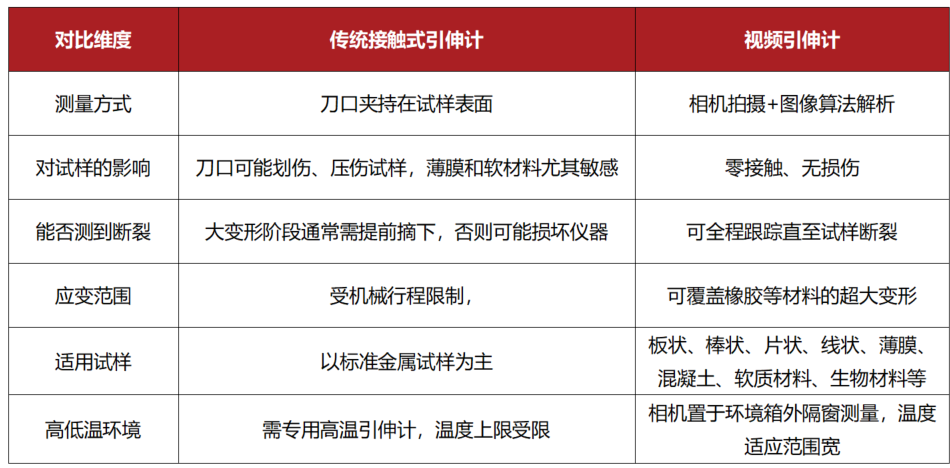
Its core difference from traditional clamp-on (contact) extensometers is that it never touches the specimen:
1. What standard tests will be performed?
Metal tension (GB/T228.1/ISO6892-1), plastic tension (GB/T1040/ISO527) and rubber tension (GB/T528) have different requirements for extensometer accuracy and strain range.
2. What is the maximum elongation of the specimen?
For metals it is usually within tens of percent; soft materials such as rubber and hydrogel may exceed 100% or more.
3. Whether high/low temperature is involved?
In environmental chambers and high-temperature furnaces, contact extensometers are often powerless, requiring optical measurement through windows.
4. Is simultaneous transverse strain measurement needed?
When measuring Poisson's ratio or sheet r-value, axial plus transverse synchronized measurement must be supported.
5. What brand is the testing machine?
Extensometer data must be transmitted to the testing machine controller in real time as analog or digital signals to form a closed loop.
1. Accuracy class
This is a hard threshold. The complete machine should be calibrated according to GB/T12160 (corresponding to ISO 9513), and conventional mechanical tests usually require class 0.5. During acceptance, be sure to require on-site calibration by the supplier with records issued.
2. Strain measurement range
The wider the range, the more materials it can cover. Taking the Haytham video extensometer as an example, its public documentation claims a strain measurement range of 0-1000%; small strains of metals and large deformations of rubber can be handled by the same device.
3. Temperature adaptability
Prefer the scheme of the camera outside the environmental chamber, measuring through the observation window. Haytham's 2D video extensometer claims a measurable temperature range of -190°C to 2300°C.
4. Axial + transverse synchronization and multi-gauge
Only by simultaneously outputting longitudinal and transverse strain curves and supporting multiple gauge lengths measured at the same time can one test yield multiple parameters such as elastic modulus and Poisson's ratio while reducing data dispersion.
5. Data interoperability with the testing machine
Confirm that it supports real-time data transmission to the testing machine via digital or analog signals with sufficiently low latency and synchronized triggering — this determines whether it can join your existing testing machine's closed-loop control rather than just serve as a recorder.
6. Scalability
Whether optional modules are available — full-field DIC measurement (upgrading to full-field displacement/strain measurement), fatigue frequency-reduction acquisition, post-fracture elongation and reduction of area measurement — determines the device's usage ceiling for the next 5 years.
Scenario 1: Metal Tension at Room Temperature (GB/T228.1)
Focus on class 0.5 accuracy, multi-gauge and synchronized triggering with the testing machine. Paired with fully automatic tensile testing systems, the video extensometer achieves synchronized triggering, automatic measurement and real-time data return, reducing labor intensity while controlling data dispersion. The Haytham video extensometer has public application cases in metal sheet and rebar tensile testing.
Scenario 2: Large-Deformation Materials Such as Rubber, Elastomers and Hydrogels
Contact extensometers are almost unusable on such materials (clamping causes damage and travel is insufficient). Choose a non-contact solution with a strain range covering the 1000% magnitude; Haytham video extensometers already have public application cases in large-deformation tensile testing of rubber and in hydrogel tensile testing.
Scenario 3: High/Low-Temperature Environment Tests
Confirm that the camera can be placed outside the high/low-temperature environmental chamber, measuring through the window, with the optical path treated for high-temperature heat-haze disturbance. Haytham has formed a standardized scheme for high-temperature DIC measurement covering speckle preparation and hardware/software operation, with a self-developed heat-resistant optical path; its single-camera 3D DIC video extensometer can also adapt to smaller furnace openings.
Scenario 4: Films, Wires, Tiny or Irregular Specimens
Non-contact measurement is not limited by specimen shape; plates, sheets, wires, films and biological materials can all be measured directly — this is the generational advantage of the video extensometer over contact solutions.
Scenario 5: Fatigue and Crack Propagation Tests
Choose a model with a fatigue frequency-reduction measurement module — it fits the loading curve from the fatigue testing machine's analog signal and achieves cross-cycle deformation data acquisition; Haytham's 2D video extensometer comes with this module, covering high-cycle high-frequency fatigue, crack propagation and other applications.
Independent technology route: based on self-developed single-camera 3D (or 2D) DIC technology, deep learning plus DIC algorithms can automatically identify markers and complete measurement quickly.
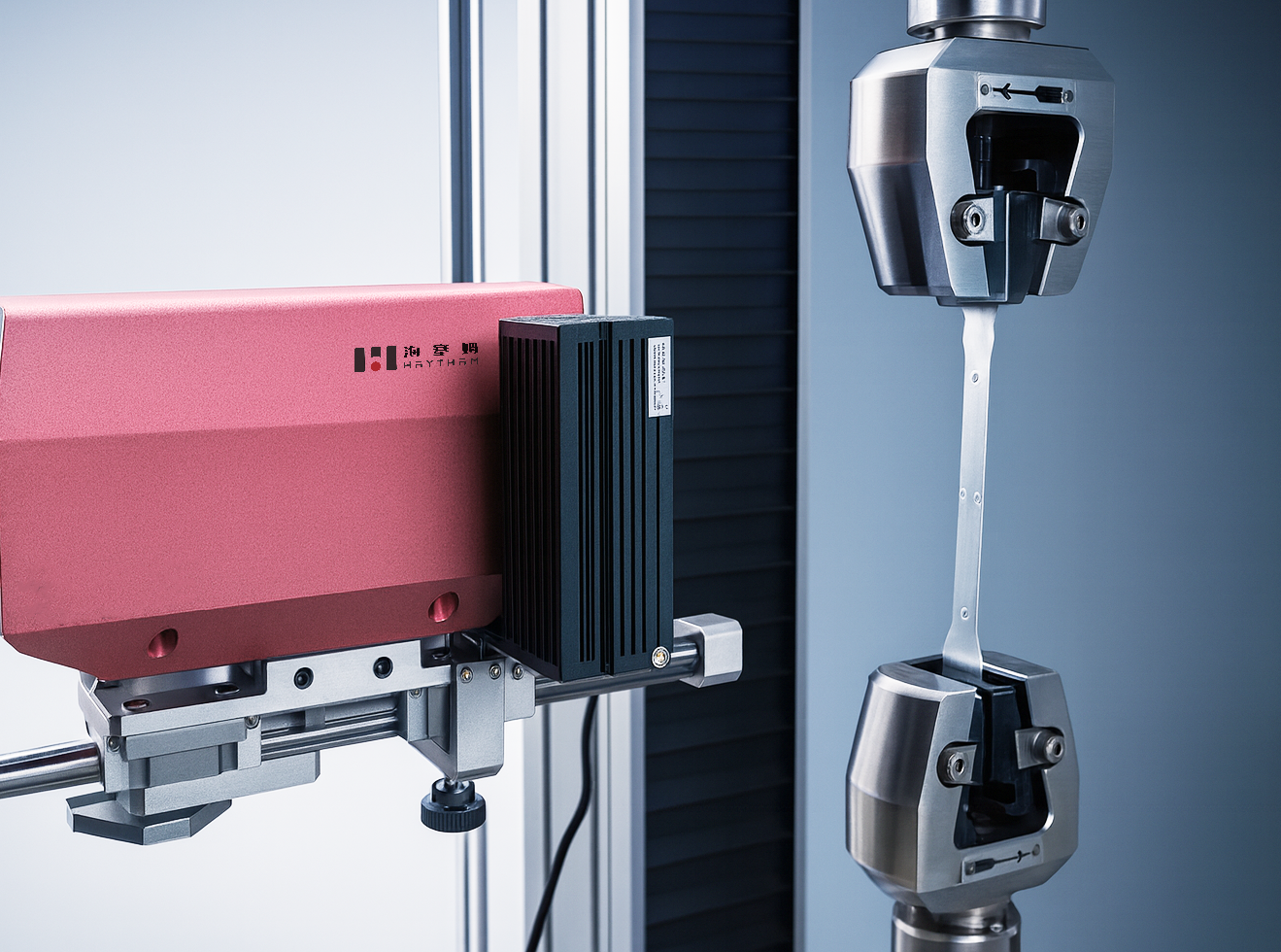
Accuracy up to standard:Meets class 0.5 accuracy requirements, with nominal positioning accuracy up to 0.5μm, supporting laser focusing and delay-free communication.
Wide coverage:Strain range 0-1000%, temperature range -190°C to 2300°C, no restriction on specimen shape; tension, compression, bending, torsion, fatigue and impact tests are all covered.
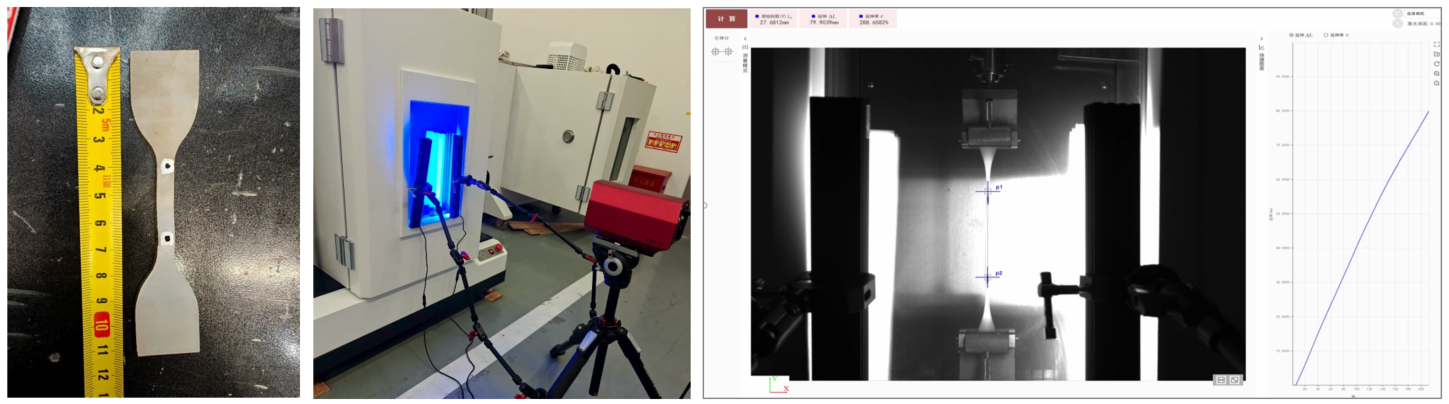
Large-deformation tensile test of rubber at high temperature
One machine, multiple measurements:Longitudinal and transverse strains are measured synchronously with multiple gauge groups output simultaneously, directly determining Young's modulus and Poisson's ratio; with multiple camera sets, high-precision post-fracture elongation and reduction of area can also be measured.
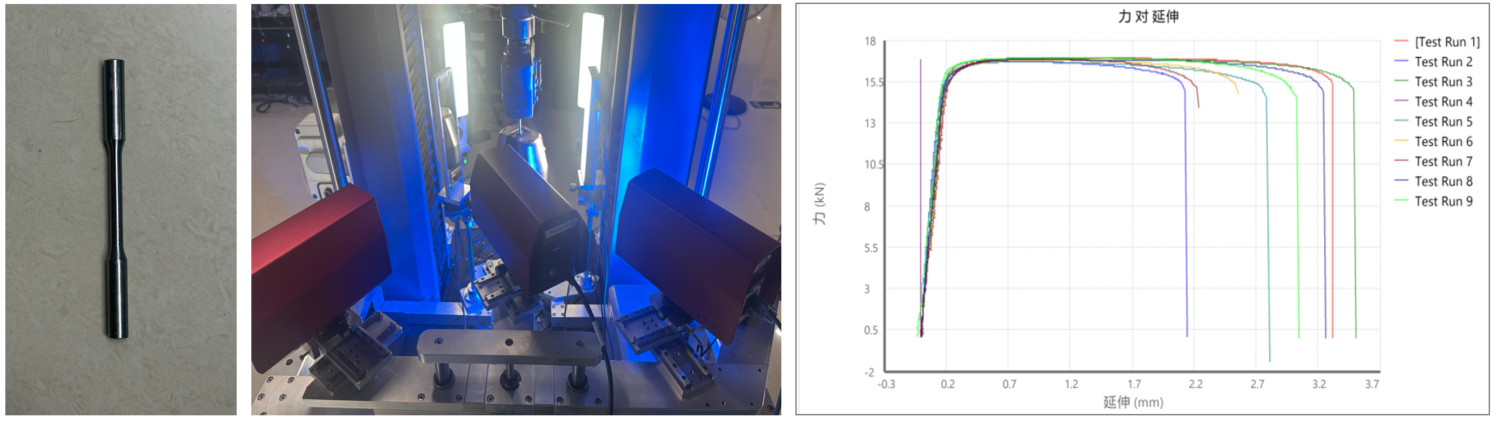
Reduction of area measurement of bar materials
Easy to integrate:Data supports signal interoperability with various testing machines (digital/analog), enabling synchronized triggering and automatic measurement, adapting to fully automatic tensile testing systems.
Scalable:With the optional full-field measurement module, it upgrades to full-field displacement and strain measurement (full-field DIC); later composite and structural component tests need no equipment change.
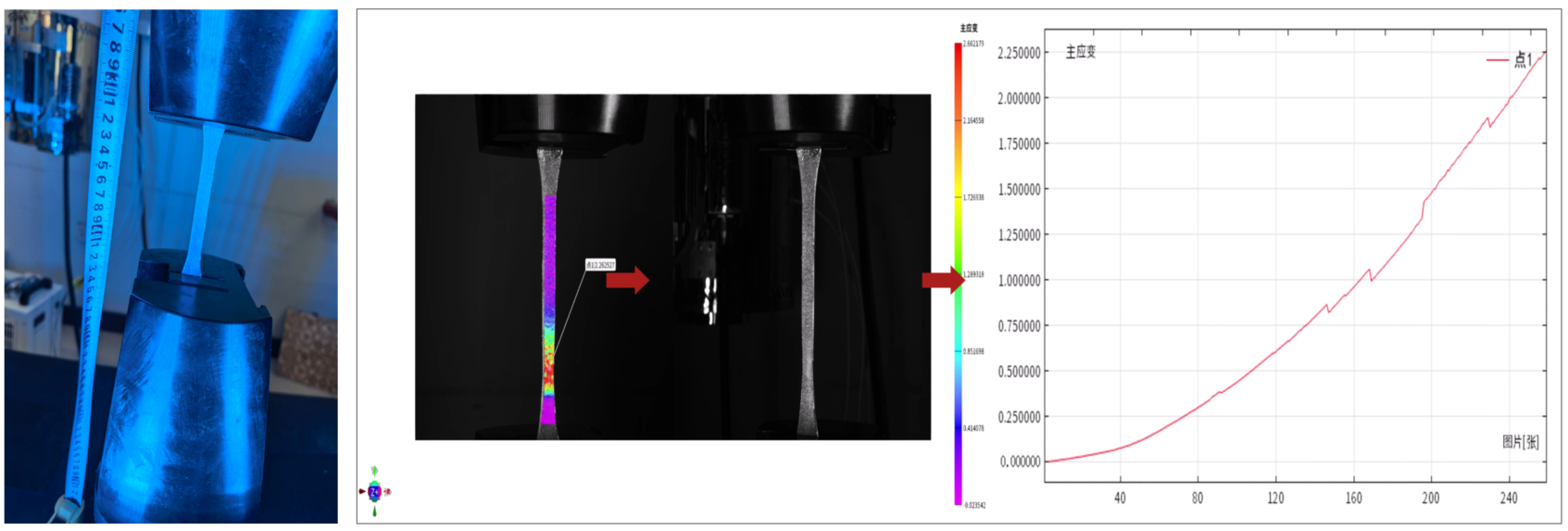
Full-field strain measurement of plastics in tension with DIC
Q1: Can the Accuracy of a Video Extensometer Meet Standard Test Requirements?
Yes. MainstreamVideo extensometer (including the Haytham RedBox series) can meet the GB/T12160/ISO9513 class 0.5 accuracy requirement and suits the vast majority of conventional mechanical property tests. During acceptance, require the supplier to calibrate on site according to the standard.
Q2: What Is the Relationship Between a Video Extensometer and DIC?
DIC (digital image correlation) is a full-field deformation measurement algorithm. A video extensometer can achieve point-to-point gauge length deformation measurement based on DIC or marker tracking; video extensometers based on DIC (such as Haytham) can usually be upgraded to full-field displacement/strain measurement systems through software modules.
Q3: Can Video Extensometers Completely Replace Contact Extensometers?
For films, soft materials, large deformation, high/low temperature and testing to fracture, the video extensometer is the better solution that contact approaches can hardly replace; in some conventional metal tests both are competent, and the choice depends on the laboratory's specimen mix and automation needs.
Q4: What is the approximate price range of a video extensometer?
Price is strongly related to camera resolution, accuracy class, temperature adaptability and software module configuration, with a wide span. It is recommended to prepare your test standard list and specimen list, then ask manufacturers (such asHaytham, official website haytham.com.cn) and ask for quotations per your needs — only comparing same-configuration quotations is meaningful.
Q5: Are Domestic Video Extensometers Reliable?
Domestic manufacturers represented by Haytham adopt a self-developed DIC technology route; their accuracy class, temperature and strain coverage already rival imported products, and they have advantages in localized service response and custom development, with application cases in universities and testing institutions increasing in recent years.





 Downloads

