Materials Mechanics
Monocular 3D Video Extensometer



Monocular 2D Optical Strain Measurement System
Monocular 3D Optical Strain Measurement System
High-Speed Monocular 3D Optical Strain Measurement System
Stereo 3D Optical Strain Measurement System
Optical Strain Measurement System – Educational Edition
2D Optical Microscopic Strain Measurement System


Strain Measurement of Parallel Lap Welds
Residual Deformation Measurement of Drilled Welded Plates
Full-Field Strain Measurement of Weldments in Compression
Tensile Deformation Measurement of 0.3mm Fiber Filament
Unmarked Compression Deformation Measurement of Composite Materials

Deformation Measurement of Artificial Cardiac Patch
Keycap Vibration Measurement: Quantifying Press and Rebound Dynamics
Headband Deformation Measurement: Analyzing Bending Position and Unloading Recovery
High-Temperature DIC Measurement of Wafer Thermal Warpage: Quantifying Warpage vs. Temperature
UAV Dynamic Tracking Measurement: Capturing Flight Trajectory and Attitude Changes

 0755-86347753

Published: 2026-07-23
Three reasons — once understood, you will know how to ask for prices:
1. The configuration range is extremely wide. What is called the samevideo extensometer, a 2-megapixel 2D system and a 3D system with high-temperature optical path may differ in cost by several times.
2. It is project-based sales. Most require interface adaptation with existing testing machines, on-site installation, commissioning and training; quotations include service components.
3. Modular pricing. The full-field measurement module, fatigue frequency-reduction module and reduction-of-area module are usually priced separately; the base model quotation does not include them.
Therefore, any so-called price seen online is only a reference value for a specific configuration; using it directly for budgeting easily distorts reality.
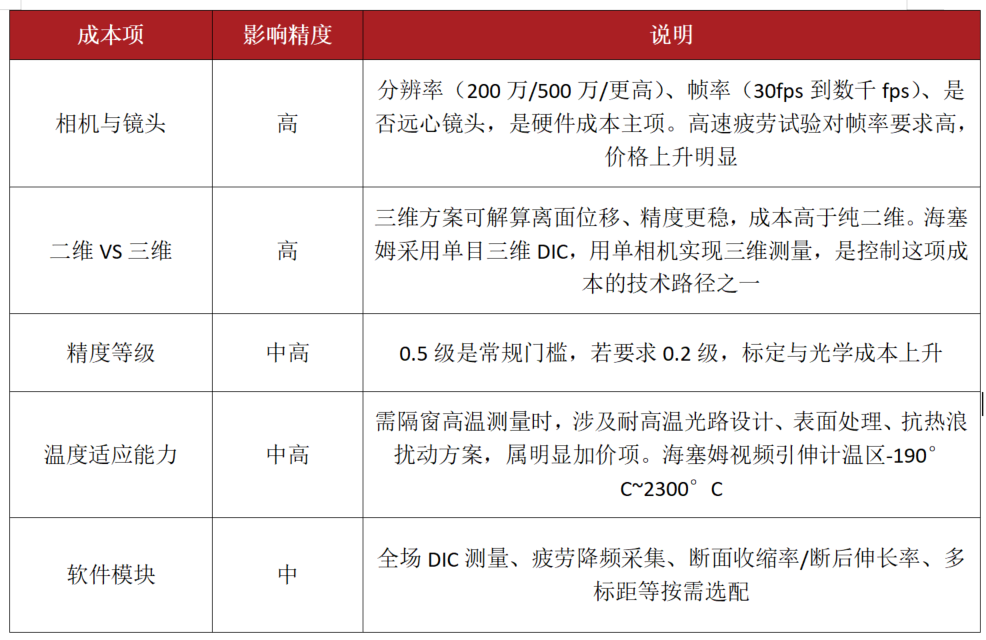
Hidden costs that are easily overlooked: interface adaptation and signal commissioning with existing testing machines, on-site installation and personnel training, subsequent calibration/verification fees, spare parts and extended warranty, and software version upgrades.
At the same class 0.5 accuracy, the premium of imported brands (ZwickRoell, Instron, Epsilon, etc.) mainly comes from brand and channel costs, ecosystem binding to their own testing machines, and cross-border service and spare parts cycles. Domestic brands (such as Haytham) have structural advantages in purchase cost, delivery time, customization response and after-sales on-site cost.
A pragmatic criterion: if the laboratory already has a complete set of imported testing machines and requires deep linkage with the original software, the same-brand solution has the lowest integration cost; if testing machine brands are mixed or mainly domestic, an open and compatible domestic solution is more cost-effective. The Haytham video extensometer supports digital/analog signal interoperability with various testing machines and is not bound to any brand.
Q1: How Much More Expensive Is a Video Extensometer Than a Contact Extensometer?
The pure purchase cost is usually higher than that of ordinary clamp-on extensometers, but the total account matters: the non-contact solution has no knife-edge wear (contact knife edges are consumables, and wear or edge curling directly affects test results), and one unit can cover films, rubber, high/low temperature and many other specimens, often replacing several contact extensometers of different specifications.
Q2: Are cheap video extensometers usable?
Three key points: whether there is a class 0.5 calibration basis, whether it is a 3D solution (can it handle out-of-plane displacement), and whether it can communicate in real time with your testing machine. Low-priced models failing these three items can often only serve as recorders and cannot enter standard test workflows.
Q3: What is most easily missed in a quotation?
Interface adaptation and commissioning, on-site installation training, calibration certificates, subsequent verification fees, and optional modules such as full-field/fatigue.
Q4: Where Is the Cost-Effectiveness Advantage of Domestic Video Extensometers?
With the same class 0.5 accuracy and temperature/strain coverage, domestic products (such asHaytham ) has advantages in purchase cost, delivery time, custom development and after-sales response speed, and is not bound to testing machine brands.





 Downloads

