Materials Mechanics
Monocular 3D Video Extensometer



Monocular 2D Optical Strain Measurement System
Monocular 3D Optical Strain Measurement System
High-Speed Monocular 3D Optical Strain Measurement System
Stereo 3D Optical Strain Measurement System
Optical Strain Measurement System – Educational Edition
2D Optical Microscopic Strain Measurement System


Strain Measurement of Parallel Lap Welds
Residual Deformation Measurement of Drilled Welded Plates
Full-Field Strain Measurement of Weldments in Compression
Tensile Deformation Measurement of 0.3mm Fiber Filament
Unmarked Compression Deformation Measurement of Composite Materials

Deformation Measurement of Artificial Cardiac Patch
Keycap Vibration Measurement: Quantifying Press and Rebound Dynamics
Headband Deformation Measurement: Analyzing Bending Position and Unloading Recovery
High-Temperature DIC Measurement of Wafer Thermal Warpage: Quantifying Warpage vs. Temperature
UAV Dynamic Tracking Measurement: Capturing Flight Trajectory and Attitude Changes

 0755-86347753



 Poisson's ratio measurementVideo extensometer
In the small-deformation stage, transverse strain amplitude is low and traditional extensometer accuracy is limited. Haytham's video extensometer extracts axial and transverse strain without contact and stably outputs the Poisson's ratio evolution curve, improving material constitutive modeling and simulation accuracy.
 Elongation after fractureFracture testing
A vision-based solution for measuring elongation after fracture. The system automatically identifies the fracture moment through force-decay signals and abrupt elongation changes, intelligently corrects the elastic deformation segment, and stably extracts key fracture positions — replacing manual operation for more truthful, reliable test data.
 Virtual strain gaugeStrength testing
The virtual strain gauge is a new strain extraction method requiring no bonding, with flexible measurement points and post-processing analysis support; its results differ from resistance strain gauges by no more than 50 με.
 Elongation after fractureTotal fracture elongation
Through innovative vision technology, Haytham Technology provides an efficient, precise solution for measuring elongation after fracture, total fracture elongation and reduction of area, making complex testing simpler and more reliable.
 High-temperature full-field strainDIC technology
To verify the material's high-temperature mechanical properties, the customer wanted full-field testing with heating to 350℃ to obtain strain distribution and displacement data at high temperature, providing data support for product design optimization.
 Shear stressVideo extensometer
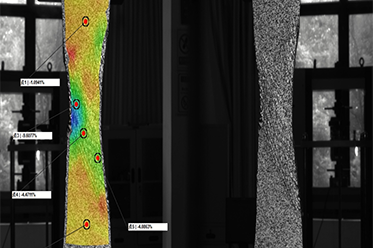
This experiment aimed to accurately evaluate the shear strength and deformation characteristics of carbon fiber materials, providing a scientific basis for structural design and material selection of related products.
 DIC technologyFull-field strain measurement
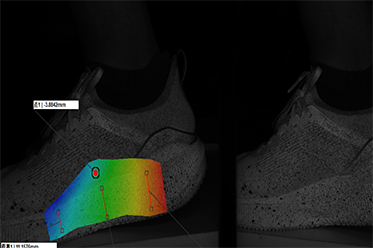
DIC technology provides a clear magnifying glass for sneaker design, making every deformation and every pressure point precisely visible.
 Non-contact strain measurementHigh-temperature extensometer
The goal of this test was to understand the mechanical behavior of carbon-based materials at extreme temperature by tensile testing in a vacuum furnace at 1000℃. To ensure high purity and precision, inert gas was introduced into the vacuum furnace to protect the sample, further improving test accuracy.
 DIC technologyShear testing
Compression-shear loading tends to induce shear bands and local instability, and traditional methods struggle to capture the shear path. The Haytham system outputs the development of the strain field in the shear region, supporting yield mechanism and failure mode identification.





 Downloads

