Materials Mechanics
Monocular 3D Video Extensometer



Monocular 2D Optical Strain Measurement System
Monocular 3D Optical Strain Measurement System
High-Speed Monocular 3D Optical Strain Measurement System
Stereo 3D Optical Strain Measurement System
Optical Strain Measurement System – Educational Edition
2D Optical Microscopic Strain Measurement System


Strain Measurement of Parallel Lap Welds
Residual Deformation Measurement of Drilled Welded Plates
Full-Field Strain Measurement of Weldments in Compression
Tensile Deformation Measurement of 0.3mm Fiber Filament
Unmarked Compression Deformation Measurement of Composite Materials

Deformation Measurement of Artificial Cardiac Patch
Keycap Vibration Measurement: Quantifying Press and Rebound Dynamics
Headband Deformation Measurement: Analyzing Bending Position and Unloading Recovery
High-Temperature DIC Measurement of Wafer Thermal Warpage: Quantifying Warpage vs. Temperature
UAV Dynamic Tracking Measurement: Capturing Flight Trajectory and Attitude Changes

 0755-86347753



 Hopkinson bar testDIC technology
In Hopkinson bar impact testing, Haytham's monocular 3D high-speed DIC better adapts to the spatial and temporal characteristics of such tests, providing a stable technical approach for recording high-speed material deformation.
 DIC, vibration testing, full-field strain
In structural dynamics experiments, the research team used Haytham's monocular 3D high-speed DIC for full-field vibration measurement of a large-scale structural scale model. High-speed cameras were placed outside the model, capturing 3D motion information of the structure surface from multiple views synchronously without physical contact.
 Lithium battery nail penetrationThermo-mechanical coupling
Haytham integrates DIC full-field strain measurement with infrared thermal imaging under unified calibrated coordinates, observing temperature fields and strain/displacement fields simultaneously in the same coordinate system and time axis — extending characterization from a single quantity to multi-physics collaborative analysis.
 Rebar tensile testingHigh-temperature extensometer
In steel property evaluation, high-temperature tensile testing is an important means of checking heat-resistance strength and plasticity. However, for rebar with rough, reflective and complex-textured surfaces, traditional contact extensometers often fail to work stably; even conventional optical methods require sprayed marking points or speckle patterns, which tend to burn off or peel at high temperature, causing data interruption or increased errors.
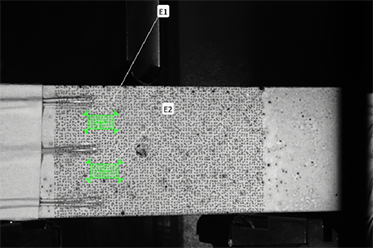 Virtual strain gaugeDICDigital image correlation
The virtual strain gauge is based on DIC algorithms rather than a physical sensor. The system computes high-precision displacement/strain from images before and after loading, creating virtual measurement points at any location on the specimen surface, with results available in real time or via post-processing.
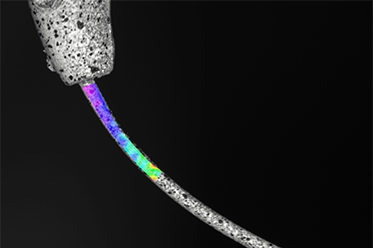 Microscopic DIC measurementWire bending fatigue testing
Haytham's visual microscopic strain measurement system uses DIC to obtain minute displacement and full-field strain distribution of earphone cables during repeated bending, accurately locating strain concentration and fatigue weak regions — a reference for cable structure optimization, life assessment and failure analysis.
 DIC technologyTungsten wire vibration testing
The tungsten wire is thin with low amplitude, making sensor attachment difficult. Haytham's monocular 3D high-speed vision strain gauge, based on monocular 3D DIC, records the entire vibration process, extracts Y-direction displacement and reconstructs mode shapes — suitable for modal frequency identification and flexible structure response analysis.
 Three-point bending testVideo extensometer
The crack initiation region is small with evident strain concentration, and traditional methods struggle to capture crack-tip evolution. The Haytham system continuously observes strain changes near the crack tip, aiding research on fracture initiation mechanisms.
 Cable bridge compressionDIC technology
The member has a long span and uncertain deformation modes, making multi-point strain gauge placement difficult. The Haytham system can set multiple gauge sections for synchronized tracking, enabling multi-section response observation and comparative analysis of cable bridges under compression.





 Downloads

