Materials Mechanics
Monocular 3D Video Extensometer



Monocular 2D Optical Strain Measurement System
Monocular 3D Optical Strain Measurement System
High-Speed Monocular 3D Optical Strain Measurement System
Stereo 3D Optical Strain Measurement System
Optical Strain Measurement System – Educational Edition
2D Optical Microscopic Strain Measurement System


Strain Measurement of Parallel Lap Welds
Residual Deformation Measurement of Drilled Welded Plates
Full-Field Strain Measurement of Weldments in Compression
Tensile Deformation Measurement of 0.3mm Fiber Filament
Unmarked Compression Deformation Measurement of Composite Materials

Deformation Measurement of Artificial Cardiac Patch
Keycap Vibration Measurement: Quantifying Press and Rebound Dynamics
Headband Deformation Measurement: Analyzing Bending Position and Unloading Recovery
High-Temperature DIC Measurement of Wafer Thermal Warpage: Quantifying Warpage vs. Temperature
UAV Dynamic Tracking Measurement: Capturing Flight Trajectory and Attitude Changes

 0755-86347753



 Cupping testVideo extensometer
In cupping tests of metal materials, Haytham's monocular 3D video extensometer significantly improves test precision and efficiency. Using monocular 3D DIC, it precisely measures full-field strain during stamping, providing important data for evaluating formability and deep-drawing performance of metals.
 High-speed dynamic testingHigh-speed camera
In lithium battery nail penetration testing, Haytham's monocular 3D high-speed vision strain gauge provides a high-precision strain measurement solution for battery safety and performance testing. The device allows engineers to capture battery shell deformation and strain distribution during penetration in real time, gaining insight into structural response under extreme conditions.
 Digital image correlation (DIC)High-speed vibration
Haytham's monocular 3D high-speed vision strain gauge uses monocular 3D DIC combined with high-speed imaging to measure full-field strain and displacement of the horn surface in real time under high-speed vibration.
 Weld strength tensileFull-field strain measurement
Haytham's monocular 3D video extensometer uses advanced monocular 3D DIC to measure full-field strain on weldment surfaces. Its high-precision camera and image processing capture minute deformation of the weld region during tension and generate full-field strain distribution maps. Compared with traditional single-point or multi-point measurement, the 3D video extensometer provides more comprehensive strain analysis with easy operation and no calibration required.
 Digital image correlation (DIC)DIC system
HALT evaluates PCB performance and durability under extreme environmental conditions within a short time. Such tests typically include rapid temperature cycling, mechanical shock and vibration. Through testing, design defects and potential failure points of the circuit board can be identified early, optimizing design and improving product reliability.
 Vibration testingDIC system
Haytham's monocular 3D vision strain gauge played an important role in simulated vibration testing of automotive AC control panels. Using monocular 3D DIC with high-precision cameras and advanced image processing, it achieved real-time, non-contact measurement of panel strain and displacement during vibration.
 CAEDIC system
Composites are widely used in aerospace, automotive manufacturing and other fields for high strength and light weight. To optimize design and ensure reliability, engineers rely on CAE simulation to predict mechanical behavior under bending loads. However, simulation accuracy must be verified with actual test data. The goal of this test was to validate CAE accuracy through bending experiments.
 Composite buckling testingVideo extensometer
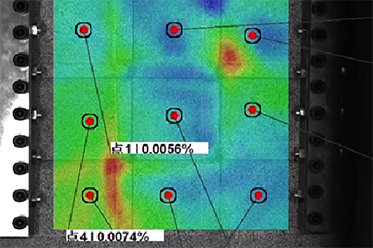
To measure strain distribution of composite materials during buckling, the test team chose Haytham's monocular 3D video extensometer. The specimen was installed in the compression machine and loaded gradually until buckling occurred. The extensometer continuously photographed the specimen surface with a single camera and computed the 3D strain distribution through DIC processing.
 Material compressionVideo extensometer
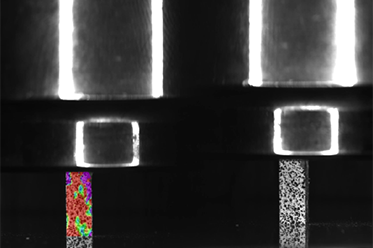
To accurately measure the strain distribution of a silicon nitride column composite during compression, the test team used Haytham's monocular 3D video extensometer. The specimen was installed in the compression machine, and the extensometer monitored surface deformation in real time via a single camera.


 Downloads

